title
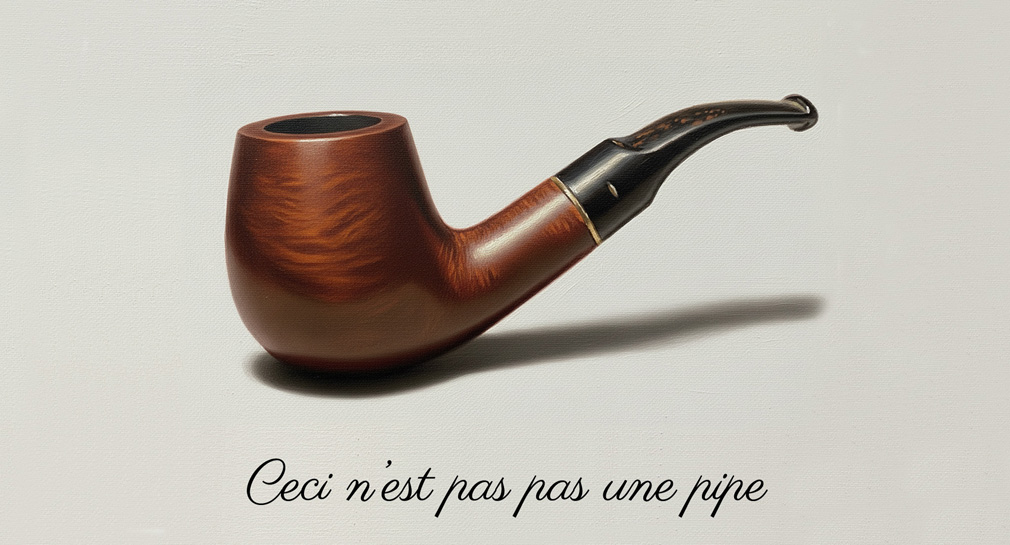
Ceci n’est pas pas une pipe 1.1
subtitle
This is not not a pipe
year
2026 04
material
digital print on linen
seize cm
A 148x80
B 111x60
C 74x40
D 37x20
info
Ai generated image mirroring René Magrittes artwork "La trahison des images", 1929
This is a pipe.
This is not an image.
This is not authorship.
The AI-generated version of “La trahison des images " (This is not a pipe) restages the paradox under new conditions.
Origin, Source, Imprint, Creation, Ownership, Transfer
"Ceci n’est pas pas une pipe" – This is not not a pipe
The image exists within overlapping systems of technology, culture and law. It is generated from collective input, shaped by cultural and economic structures, and in no time circulated through digital networks.
What appears as a singular work is in fact a condensation of many.
The original is no longer a point—it is a field.
What is presented is not simply a depiction, but an accumulation—an image constructed from prior visual and textual data.
This is not an image.
This is not authorship.
The AI-generated version of “La trahison des images " (This is not a pipe) restages the paradox under new conditions.
Origin, Source, Imprint, Creation, Ownership, Transfer
"Ceci n’est pas pas une pipe" – This is not not a pipe
The image exists within overlapping systems of technology, culture and law. It is generated from collective input, shaped by cultural and economic structures, and in no time circulated through digital networks.
What appears as a singular work is in fact a condensation of many.
The original is no longer a point—it is a field.
What is presented is not simply a depiction, but an accumulation—an image constructed from prior visual and textual data.
Where René Magritte questioned representation, this iteration questions origin, ownership, and the conditions of production.
The work no longer resides within a fixed category but operates as tension between individuality – collectivity, protection – access and originality – transformation.
Origin – Cultures and Context
All images are produced within a social context. They are shaped by shared knowledge, visual culture, and historical references. No image emerges in isolation.
Every act of creation is embedded within a network of references, influences, and shared visual languages.
This becomes evident when compared to scientific knowledge, which depends on openness and reuse. If knowledge were treated with the same rigidity as copyrighted material, progress is barely possible, suspended by restrictions.
Cultural production, like scientific inquiry, relies on continuity and transformation.
Source – The Collective Archive
The data that underpins AI systems is also inseparable from the history of the internet as a space of shared knowledge production.
Much of this content has been created and distributed freely by individuals contributing to a collective resource. Software, Tutorials, explanations, creative works, and everyday expressions form an huge archive of human knowledge and specific experience.
This collective effort, initially driven by participation rather than profit, has become a foundational resource for computational systems.
The transformation of shared knowledge into a form of extractable data shifts the relationship between contribution, ownership, and value.
Creation – Data aggregation
AI models are trained on extensive datasets composed of images, texts, and other cultural artifacts (often also without direct attribution or compensation).
The outputs generated by these systems appear novel, yet they are fundamentally dependent on pre-existing material. This creates a recursive loop in which images are continuously remodeled from prior inputs.
By operating through large-scale aggregation artificial intelligence intensifies existing dynamics.
Ownership & Copyright
The copyright is hacked and the original is questioned. The gesture echoes René Magritte, yet it moves into the terrain of ownership and collective input.
Copyright establishes a framework that defines ownership, authorship, and the conditions under which images may circulate.
It protects artistic production by granting exclusive rights, yet simultaneously possibly removing works from open cultural exchange. The image and the image of the image becomes enclosed, regulated through permissions and licenses, and integrated into systems of economic value.
At the same time, AI enables the production of works that can circumvent traditional copyright frameworks by generating new variations, raising questions about the limits and relevance of ownership in such contexts.
Markets & Value
Artistic production is often dependent on institutional structures—galleries, publishers, music labels—that form networks of visibility and circulation. These intermediaries shape desire and construct value, often requiring artists to relinquish rights in exchange for visibility.
In many cases, artists relinquish rights to their work in exchange for access to these networks, resulting in a redistribution of ownership. The work becomes part of an economic system where its value is determined not only by its content but by its circulation.
Attempts by artists (eg. Damien Hirst, Taylor Swift,…) to bypass these structures highlight the instability of ownership and the ongoing negotiation between creation and control.
Transfer– Knowledge Systems
Approaches to authorship and ownership are not universal. Western models tend to emphasize individual rights and the protection of intellectual property, while other traditions—found largely in Asia—prioritize continuity, adaptation, collective development. In these frameworks the transfer of knowledge works through reenactment of the given instructions, where copying the gestures (e.g. writing) or the master is how you learn.
In these contexts, cultural production is seen less as isolated output and more as an ongoing process.
The strict separation between original and copy becomes less relevant, replaced by a model in which knowledge evolves through repetition and variation.
This creates a fundamental collision between systems that restrict and those that enable the flow of cultural material.
Transfer – Copying, Repetition and Embodiment
In many cultural contexts, Copying is not only reproduction—it is a method of learning. Repetition is used to internalize knowledge, to translate observation into embodied understanding.
Repetition functions as a means of internalization, where knowledge is not only conceptual but embodied through practice. Drawing, writing, or performing the same gesture repeatedly allows for a deeper form of understanding that exceeds surface-level comprehension.
This stands in contrast to rigid frameworks of restriction, where engagement with existing works is limited.
The tension between copying as learning and copying as infringement reveals differing conceptions of how knowledge and culture are transmitted.
Authorship
AI-generated images produce outputs by the act of prompting reshaping the act of making. This produces a condition in which authorship is diffused across datasets, algorithms, and users. The image can no longer be clearly categorized as original or copy, owned or shared. Instead, it exists within overlapping systems that define and contest its status.
Origin – Cultures and Context
All images are produced within a social context. They are shaped by shared knowledge, visual culture, and historical references. No image emerges in isolation.
Every act of creation is embedded within a network of references, influences, and shared visual languages.
This becomes evident when compared to scientific knowledge, which depends on openness and reuse. If knowledge were treated with the same rigidity as copyrighted material, progress is barely possible, suspended by restrictions.
Cultural production, like scientific inquiry, relies on continuity and transformation.
Source – The Collective Archive
The data that underpins AI systems is also inseparable from the history of the internet as a space of shared knowledge production.
Much of this content has been created and distributed freely by individuals contributing to a collective resource. Software, Tutorials, explanations, creative works, and everyday expressions form an huge archive of human knowledge and specific experience.
This collective effort, initially driven by participation rather than profit, has become a foundational resource for computational systems.
The transformation of shared knowledge into a form of extractable data shifts the relationship between contribution, ownership, and value.
Creation – Data aggregation
AI models are trained on extensive datasets composed of images, texts, and other cultural artifacts (often also without direct attribution or compensation).
The outputs generated by these systems appear novel, yet they are fundamentally dependent on pre-existing material. This creates a recursive loop in which images are continuously remodeled from prior inputs.
By operating through large-scale aggregation artificial intelligence intensifies existing dynamics.
Ownership & Copyright
The copyright is hacked and the original is questioned. The gesture echoes René Magritte, yet it moves into the terrain of ownership and collective input.
Copyright establishes a framework that defines ownership, authorship, and the conditions under which images may circulate.
It protects artistic production by granting exclusive rights, yet simultaneously possibly removing works from open cultural exchange. The image and the image of the image becomes enclosed, regulated through permissions and licenses, and integrated into systems of economic value.
At the same time, AI enables the production of works that can circumvent traditional copyright frameworks by generating new variations, raising questions about the limits and relevance of ownership in such contexts.
Markets & Value
Artistic production is often dependent on institutional structures—galleries, publishers, music labels—that form networks of visibility and circulation. These intermediaries shape desire and construct value, often requiring artists to relinquish rights in exchange for visibility.
In many cases, artists relinquish rights to their work in exchange for access to these networks, resulting in a redistribution of ownership. The work becomes part of an economic system where its value is determined not only by its content but by its circulation.
Attempts by artists (eg. Damien Hirst, Taylor Swift,…) to bypass these structures highlight the instability of ownership and the ongoing negotiation between creation and control.
Transfer– Knowledge Systems
Approaches to authorship and ownership are not universal. Western models tend to emphasize individual rights and the protection of intellectual property, while other traditions—found largely in Asia—prioritize continuity, adaptation, collective development. In these frameworks the transfer of knowledge works through reenactment of the given instructions, where copying the gestures (e.g. writing) or the master is how you learn.
In these contexts, cultural production is seen less as isolated output and more as an ongoing process.
The strict separation between original and copy becomes less relevant, replaced by a model in which knowledge evolves through repetition and variation.
This creates a fundamental collision between systems that restrict and those that enable the flow of cultural material.
Transfer – Copying, Repetition and Embodiment
In many cultural contexts, Copying is not only reproduction—it is a method of learning. Repetition is used to internalize knowledge, to translate observation into embodied understanding.
Repetition functions as a means of internalization, where knowledge is not only conceptual but embodied through practice. Drawing, writing, or performing the same gesture repeatedly allows for a deeper form of understanding that exceeds surface-level comprehension.
This stands in contrast to rigid frameworks of restriction, where engagement with existing works is limited.
The tension between copying as learning and copying as infringement reveals differing conceptions of how knowledge and culture are transmitted.
Authorship
AI-generated images produce outputs by the act of prompting reshaping the act of making. This produces a condition in which authorship is diffused across datasets, algorithms, and users. The image can no longer be clearly categorized as original or copy, owned or shared. Instead, it exists within overlapping systems that define and contest its status.
1
ADDITIONAL
1_1
The Treachery of Images
René Magritte, 1929, 81.12 cm x 60.33 cm
The painting, widely referred to as “This Is Not a Pipe” (Ceci n’est pas une pipe), presents the image of a pipe with the inscription “Ceci n’est pas une pipe” beneath it.
The work challenges our perception of images and the nature of reality.
It shows that an image is not reality, but a representation.
Although we see a pipe, it is only a painted image—not a real object. By adding the phrase “This is not a pipe,” he highlights the gap between what we see and what actually exists.
René Magritte, 1929, 81.12 cm x 60.33 cm
The painting, widely referred to as “This Is Not a Pipe” (Ceci n’est pas une pipe), presents the image of a pipe with the inscription “Ceci n’est pas une pipe” beneath it.
The work challenges our perception of images and the nature of reality.
It shows that an image is not reality, but a representation.
Although we see a pipe, it is only a painted image—not a real object. By adding the phrase “This is not a pipe,” he highlights the gap between what we see and what actually exists.
2
SCIENCE
2_1
Francis Bacon [1561 –1626)Novum Organum (1620), (The New Tool)
English philosopher who pioneered scientific knowledge through inductive reasoning and the observation of nature. (before: Aristotelian Deduction)
Novum Organum provides a framework with a practical, systematic way of uncovering the truths of nature.
Bacon uses these three insects as a famous metaphor for the different types of researchers and how they handle "data".
The Ant (The Empiricist): Only collects and consumes. It gathers raw data and facts but does not process or transform them into deeper understanding.
uses these three insects as a famous metaphor for the different types of researchers and how they handle "data."
The Spider (The Rationalist): Spins webs out of its own substance. It creates complex theories and systems entirely from its own mind, without relying on external reality.
The Bee (The True Philosopher): The middle path. It gathers material from the world (flowers) but uses its own "digestive" power to transform that material into something new and useful (honey). Francis Bacon, Novum Organum (1620), Aphorism XCV (95), Book One,
3
PHILOSOPHY
3_1
Jean Baudrillard (1929 – 2007)The Simulacrum
Reality and meaning is replaced with symbols and signs. What we experience as "reality" is actually a simulation. Seduced by the spectacle.
Hyperreality is a condition where the distinction between the "real" and the "simulation" collapses. You can’t tell where the theme park ends and the world begins.
The "map" has become more real than the "territory”.
3_2
Vilém Flusser (1920 – 1991)The Automated Image
The apparatus programs not only the image but the user.
We are no longer subjects using tools; we have become functionaries serving the apparatus. The program generates the image.
The apparatus collapses historical time into a surface. Historically, images were meant to explain the world. Now, the world is used to illustrate images.
Something is “real" if it can be transformed into a technical image.
3_3
Paul Virilio [1932 – 2018)Speed
When movement becomes instantaneous, space collapses, and so does the interval where meaning once lived.
Virilio does not focus ont the content of media, he lookes at its velocity.
The evolution of technology is the history of increasing speed (also adriver of politics and war). The faster things move, the less time we have for reflection or democratic deliberation.
2
.
1
.
May 17th, 2026