title
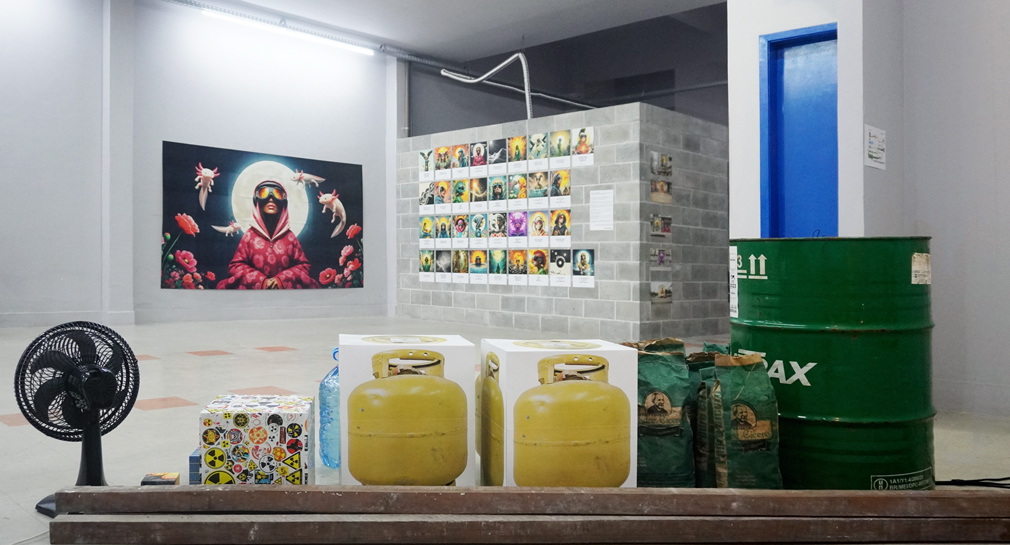
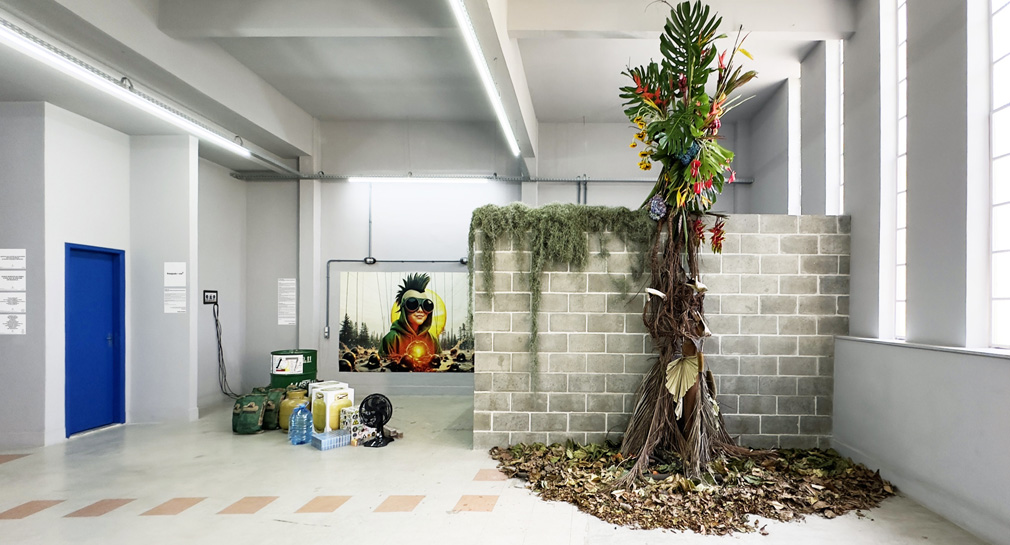
Futuregirl 1.1 – 1.7

subtitle
Auren Lumina – The future is so bright you've got to wear shades [a spiritual aproach for an affirmative future]
year
2025
materials
Photo, Video, Object, Installation
exhibition
info
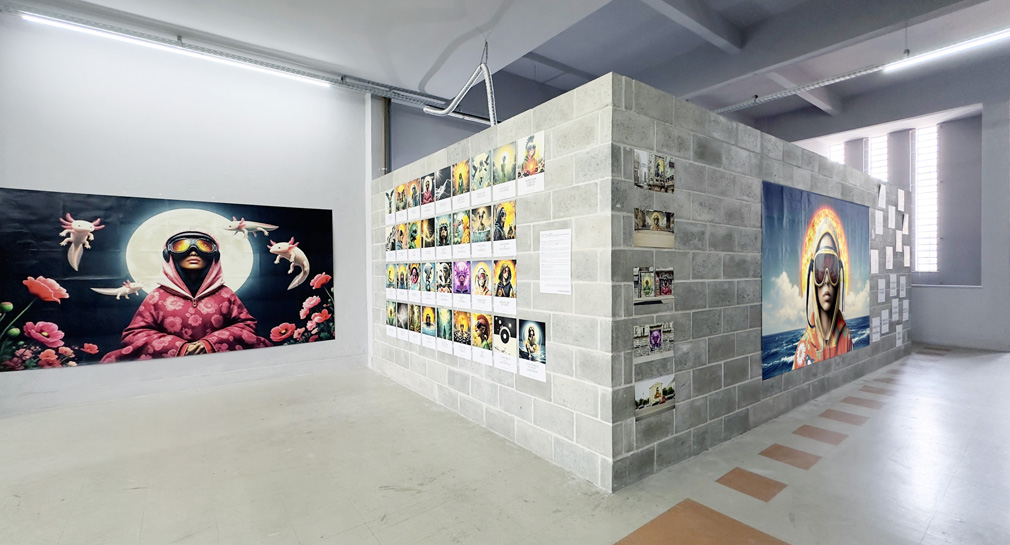
Ai generated images by using text prompts.
title
Futuregirl – Auren Lumina 1.1
info
Earthkind – An affirmative vision of the future, rooted in planetary realities
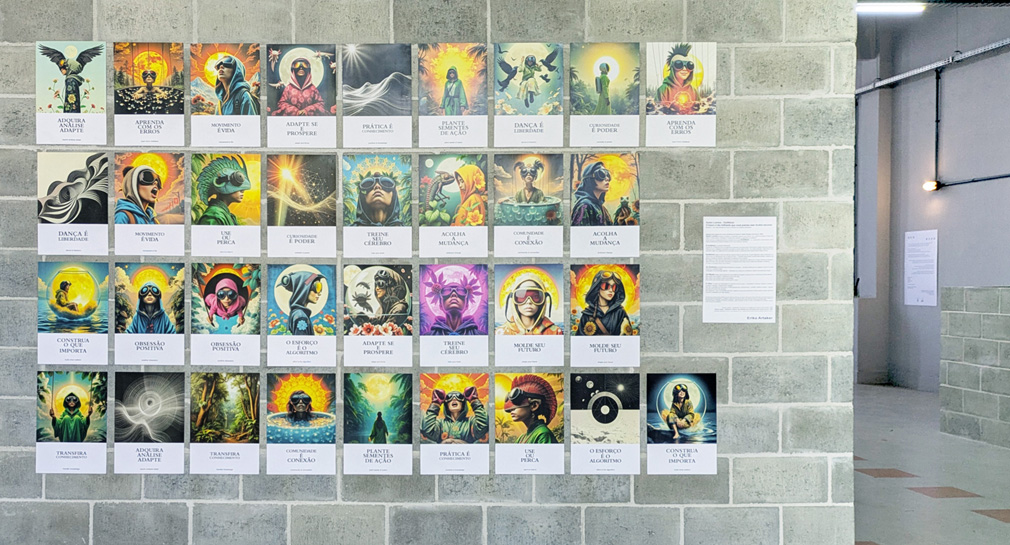
embrace change
shape your future
transfer knowledge
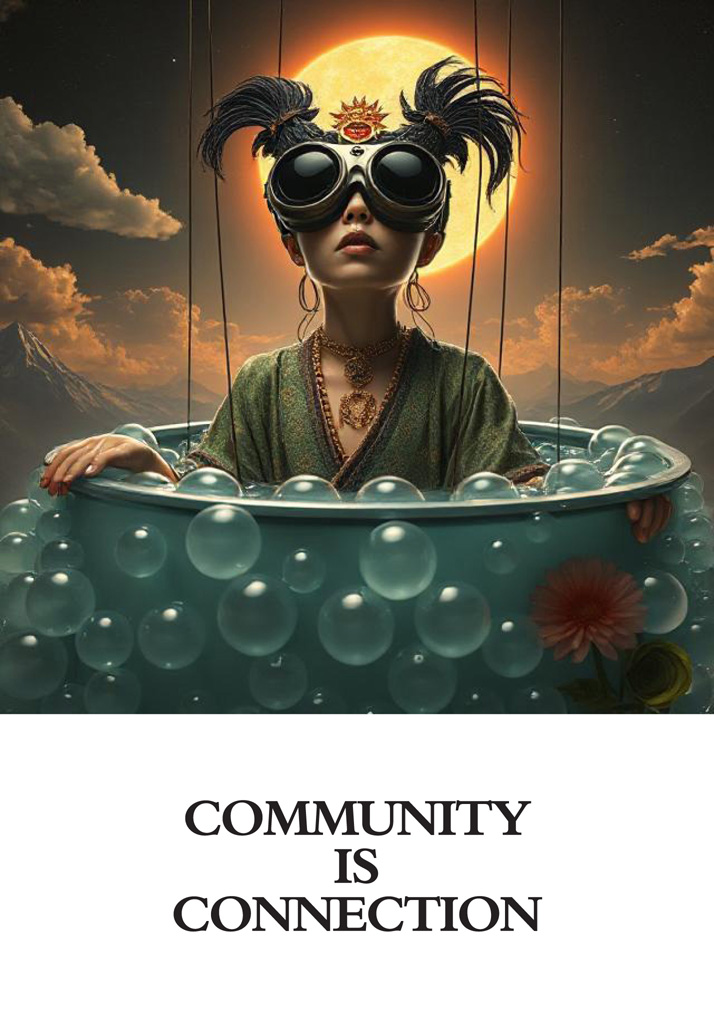
community is connection
plant seeds of action
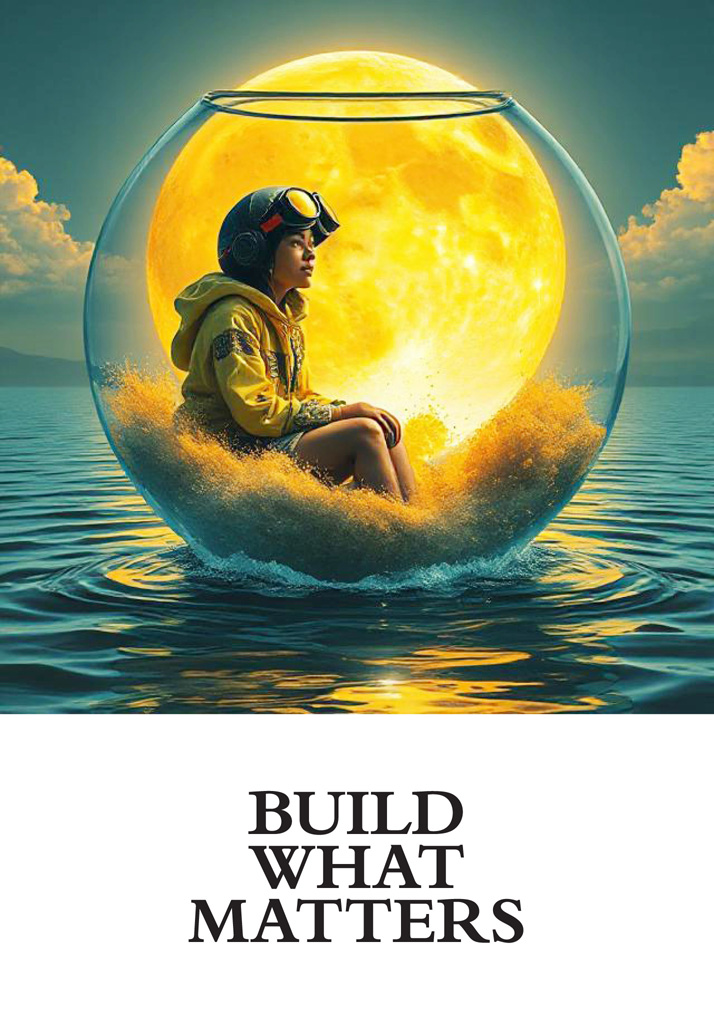
build what matters
positive obsession
curiosity is power
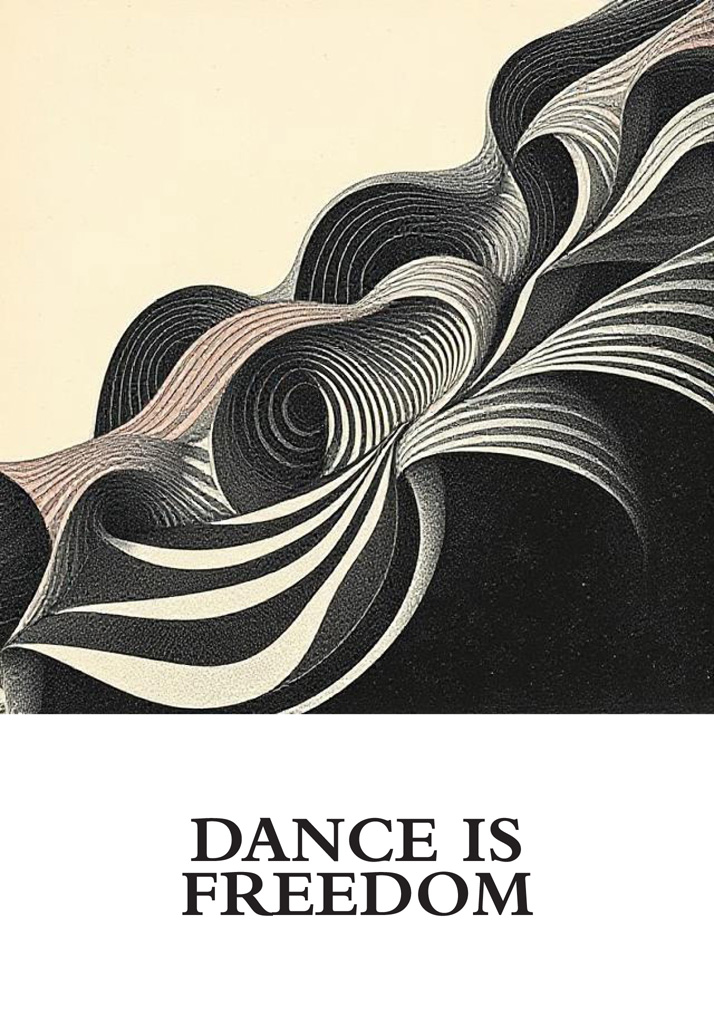
dance is freedom
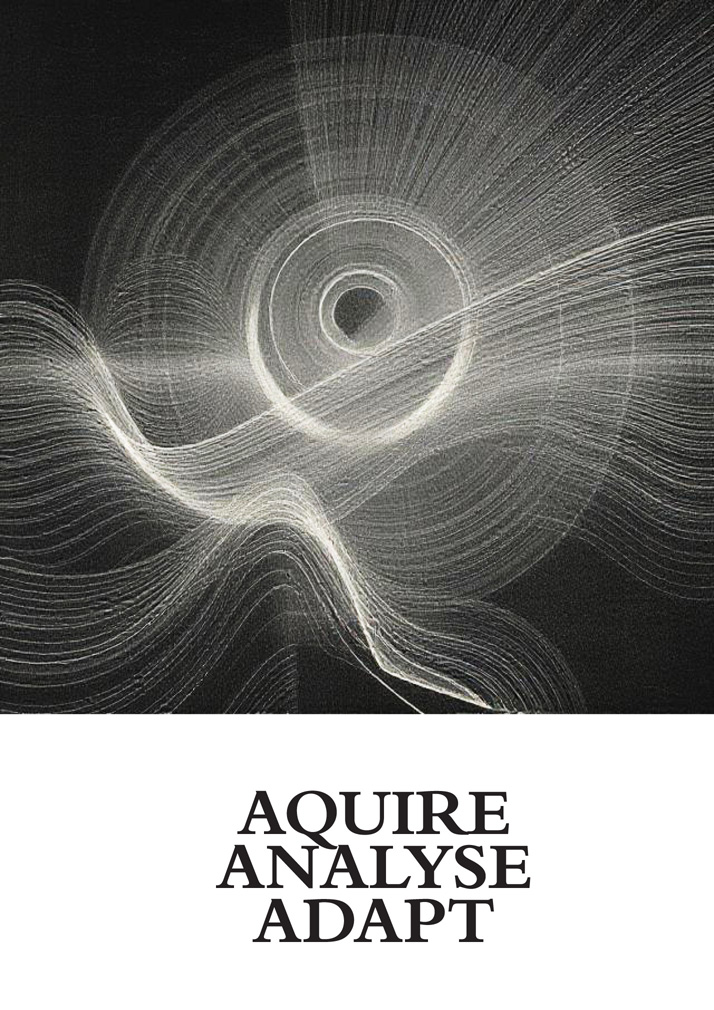
aquire analyse adapt
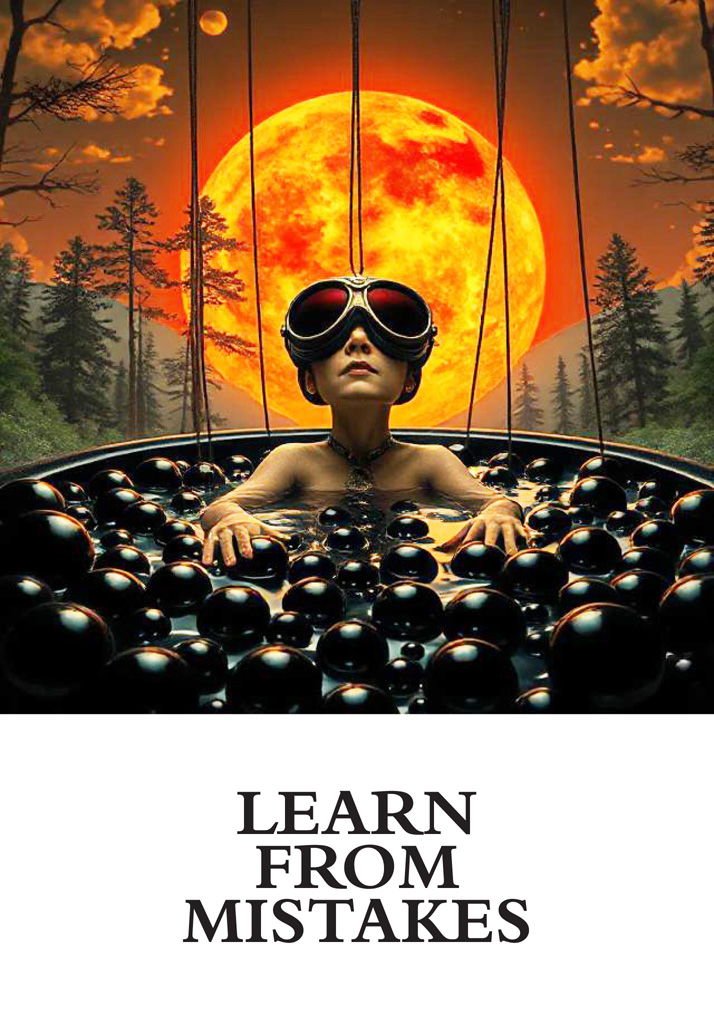
learn from mistakes
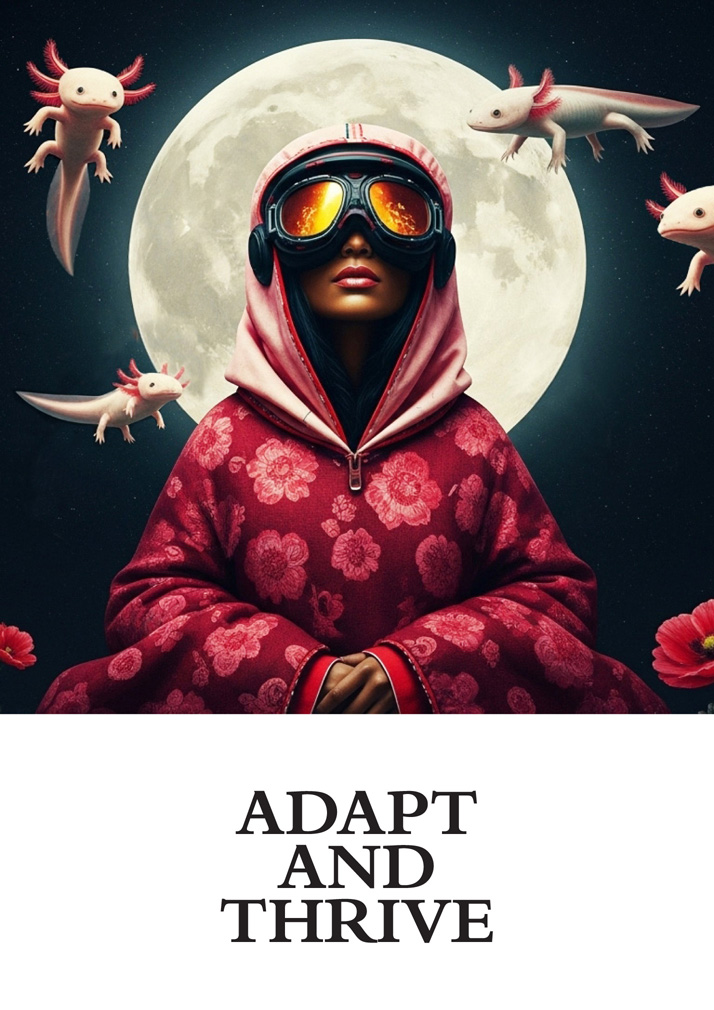
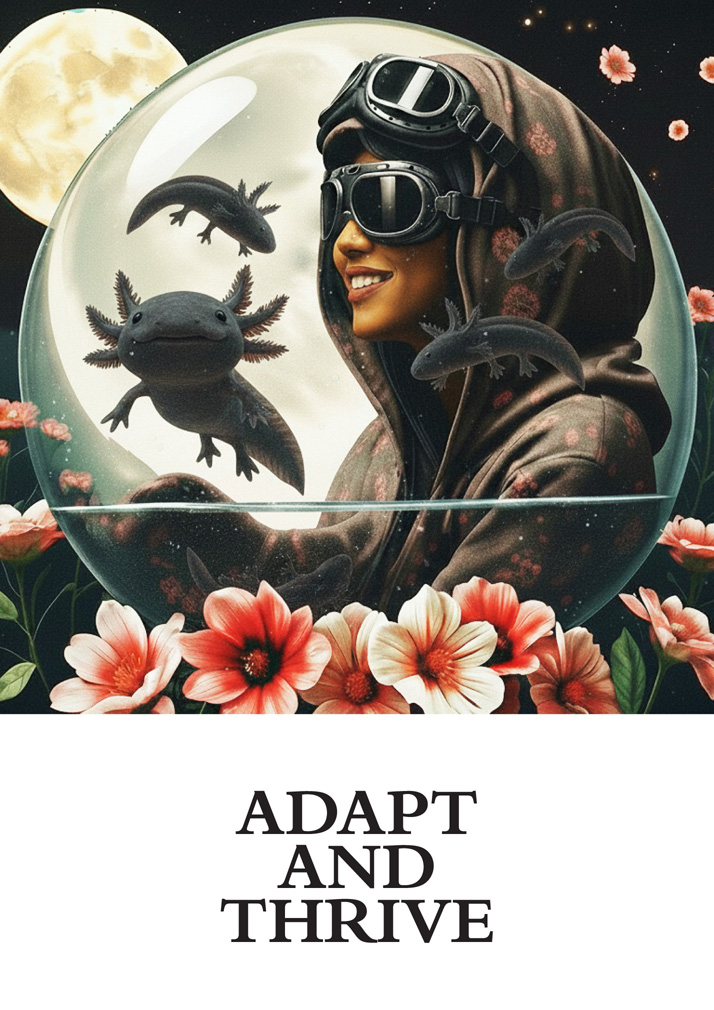
adapt and thrive
train your brain
use it or lose it
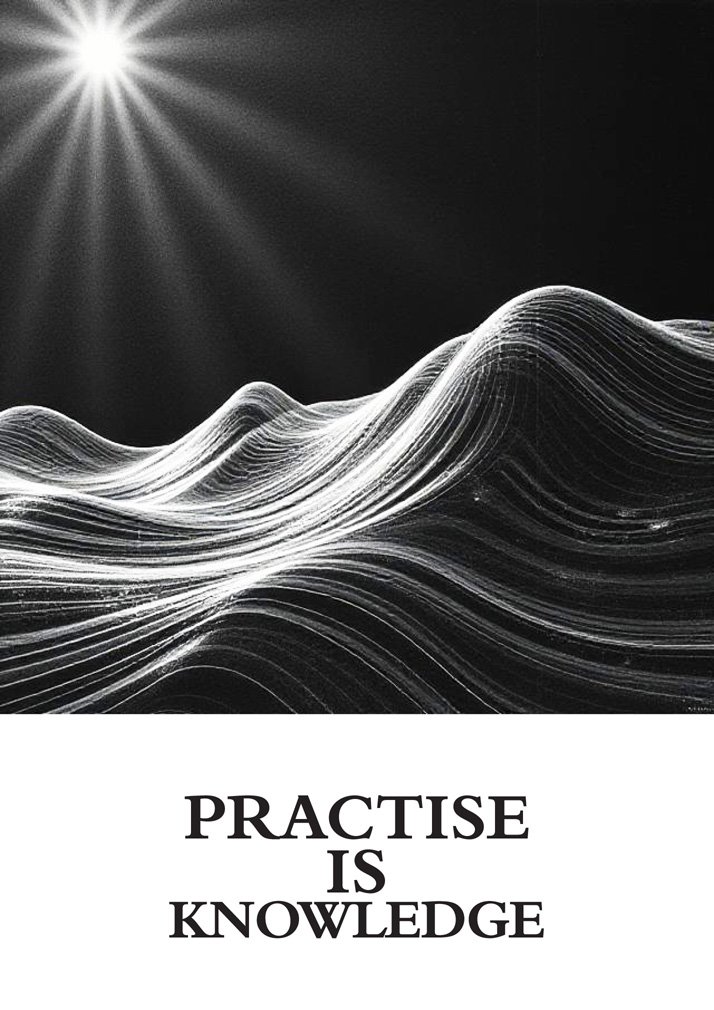
practice is knowledge
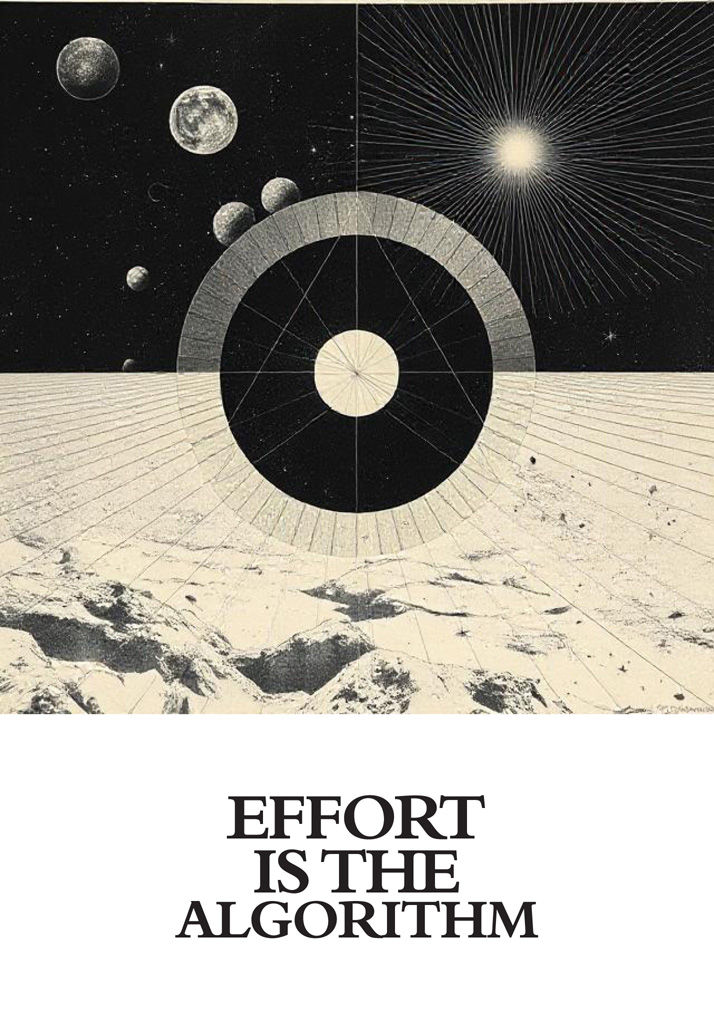
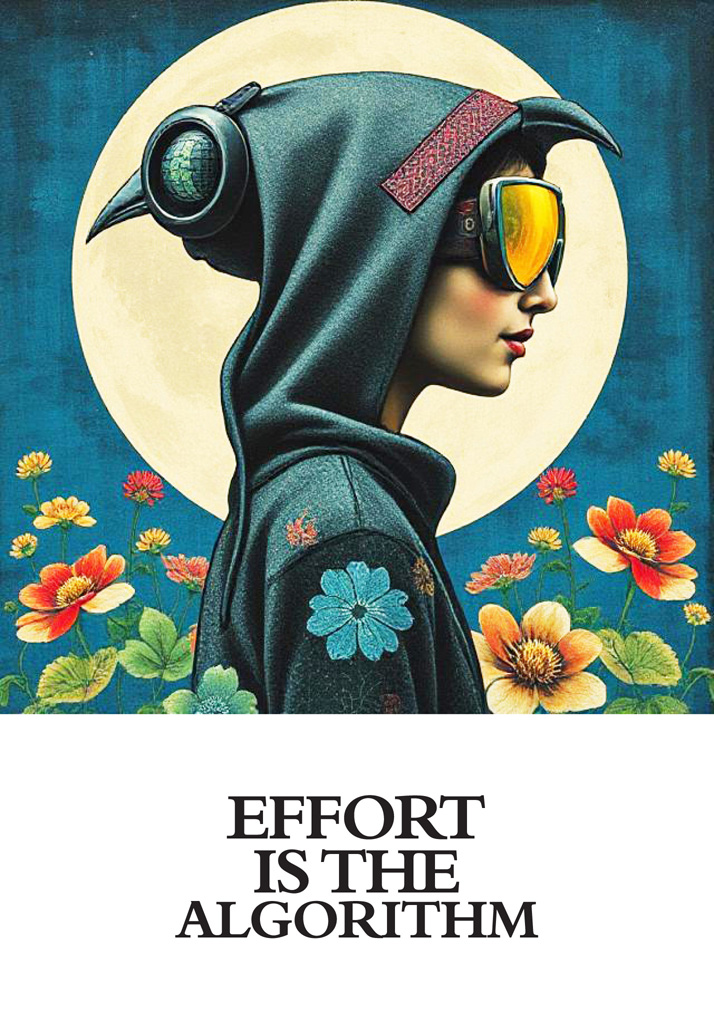
effort is the algorithm
shape your future
transfer knowledge
community is connection
plant seeds of action
build what matters
positive obsession
curiosity is power
dance is freedom
aquire analyse adapt
learn from mistakes
adapt and thrive
train your brain
use it or lose it
practice is knowledge
effort is the algorithm
The affirmative vision of the future is, rooted in planetary realities.
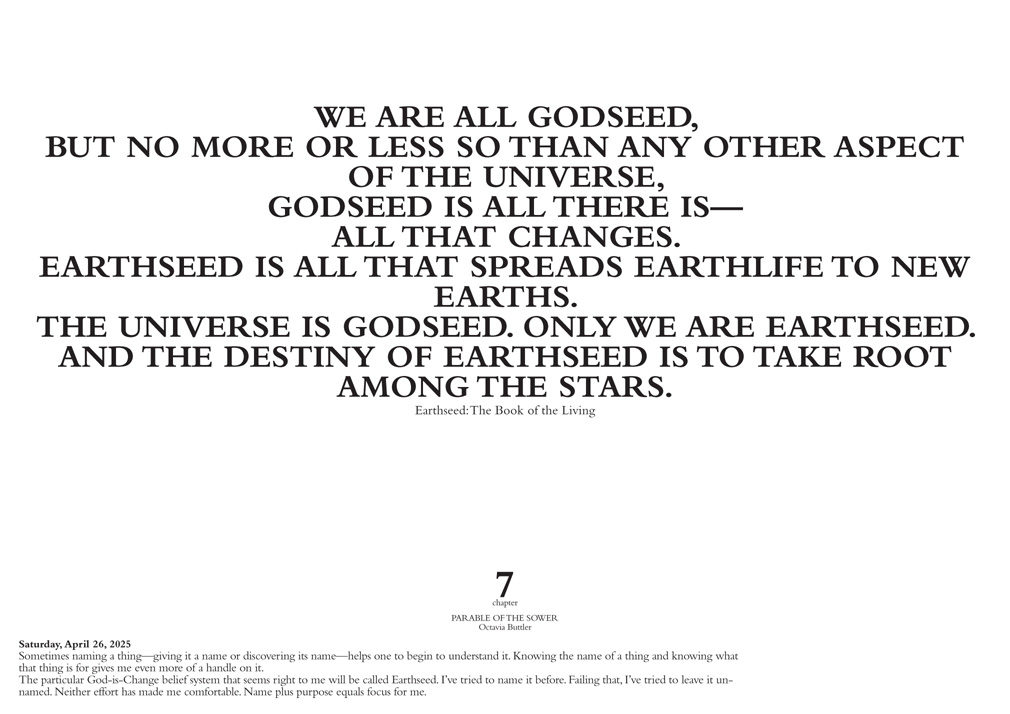
Inspired by Octavia E. Butler’s Earthseed belief system (Parable of the Sower, 1993)*, Auren Lumina embodies the prophecy and visual expression of a new faith, with the power to project an affirmative, interconnected future rooted in values that sustain meaning and existence.
Auren becomes the protagonist of the evolving faith Earthkind— expanding, reinterpreting, and illuminating the essence of Butler’s novel into a new visionary continuum.
Inspired by Octavia E. Butler’s Earthseed belief system (Parable of the Sower, 1993)*, Auren Lumina embodies the prophecy and visual expression of a new faith, with the power to project an affirmative, interconnected future rooted in values that sustain meaning and existence.
Auren becomes the protagonist of the evolving faith Earthkind— expanding, reinterpreting, and illuminating the essence of Butler’s novel into a new visionary continuum.


Change is the fundamental principle.
Time flows, matter moves, and systems expand and develop. Movement is the natural state of existence.
To align with reality is to recognize that all things are in flux, that our perception, growth, and understanding arise from engaging in a circular and balanced practice within this continual transformation.
Earthkind projects into a future that affirms life in all its forms, where human imagination, action, and growth flow in alignment with the rhythms of the Earth —
as every choice reverberates through the biosphere, shaping not only individual existence but also the living systems of the planet.
It envisions a future that engages consciously, accountably, and creatively with the world, honoring the interdependence of all life, which is embedded in and inseparable from the cycles, flows, and networks that sustain existence.
(The goal is a prospering planet under the stars)
The Guidelines of Earthkind are evolving protocols—practical principles that adapt as humans and the planet change.
Language is a sacred technology — meant to be used with awareness and respect for the power it holds.
Time flows, matter moves, and systems expand and develop. Movement is the natural state of existence.
To align with reality is to recognize that all things are in flux, that our perception, growth, and understanding arise from engaging in a circular and balanced practice within this continual transformation.
Earthkind projects into a future that affirms life in all its forms, where human imagination, action, and growth flow in alignment with the rhythms of the Earth —
as every choice reverberates through the biosphere, shaping not only individual existence but also the living systems of the planet.
It envisions a future that engages consciously, accountably, and creatively with the world, honoring the interdependence of all life, which is embedded in and inseparable from the cycles, flows, and networks that sustain existence.
(The goal is a prospering planet under the stars)
The Guidelines of Earthkind are evolving protocols—practical principles that adapt as humans and the planet change.
Language is a sacred technology — meant to be used with awareness and respect for the power it holds.
The Rituals exist to provide a grounded, prosperous existence within the framework of our planet.
They exist to emphasize respect for everything around you.
They exist to emphasize our communities.
They exist to engage both our minds and our bodies.
The Clergy: The Order of Continuance is the living memory of the world—to share is to continue;
to remember is to build.
Change is sacred; forgetting is dangerous.
They are the guardians of transmission. The Order ensures that knowledge—scientific, artistic, and cultural—flows unbroken across generations.
They secure what humanity has learned, adapting it for the next minds to build upon, honoring adaptation as sacred.
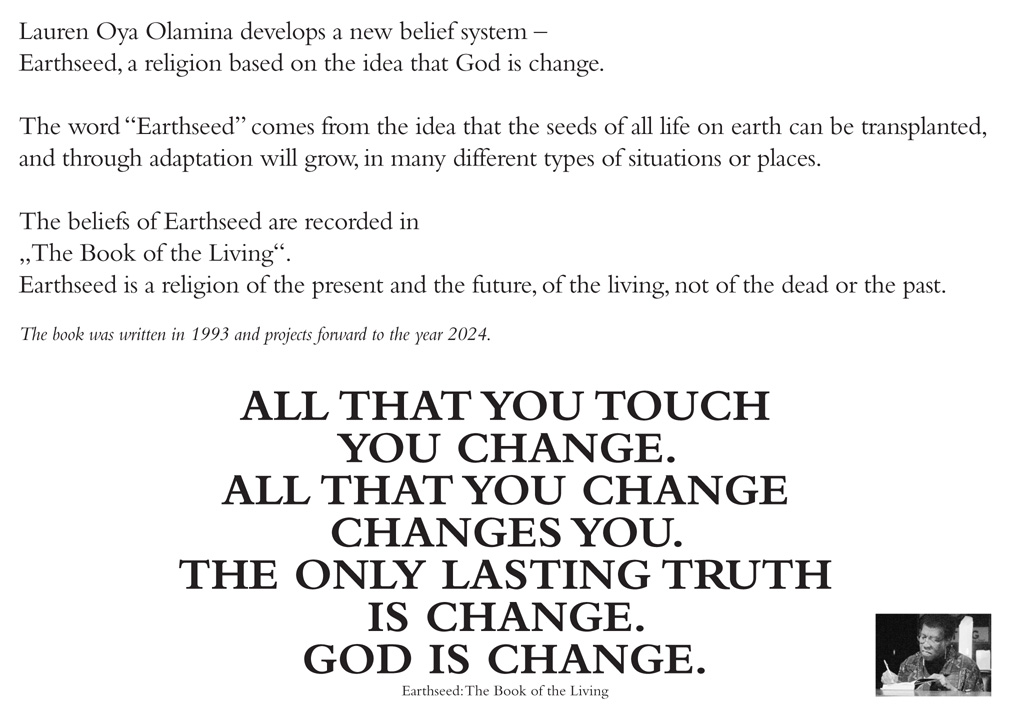
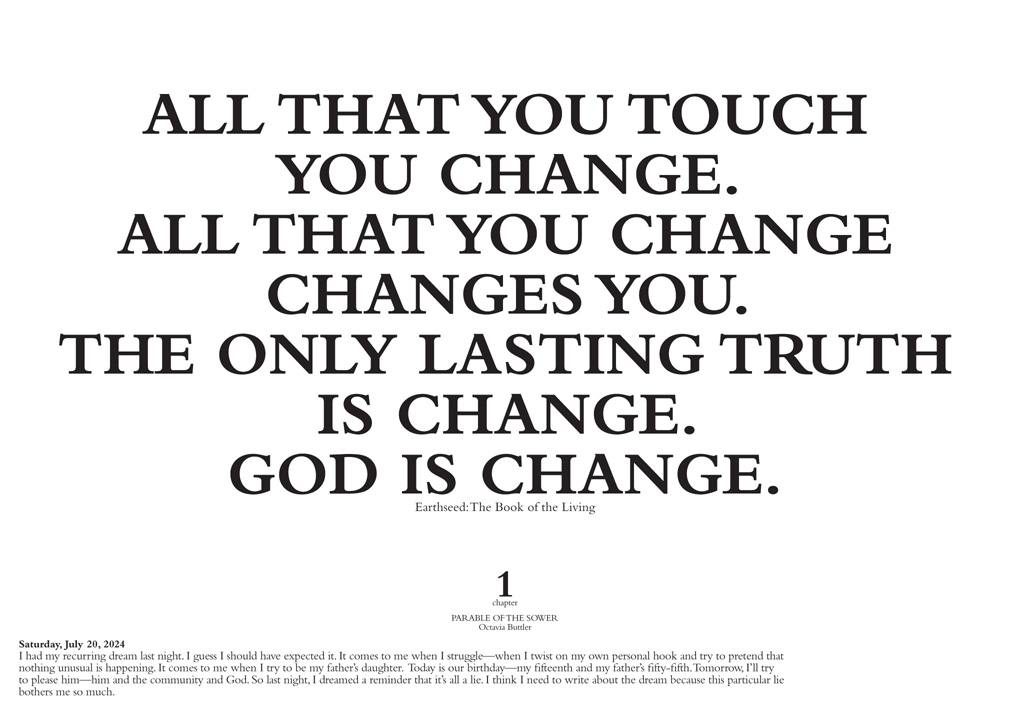
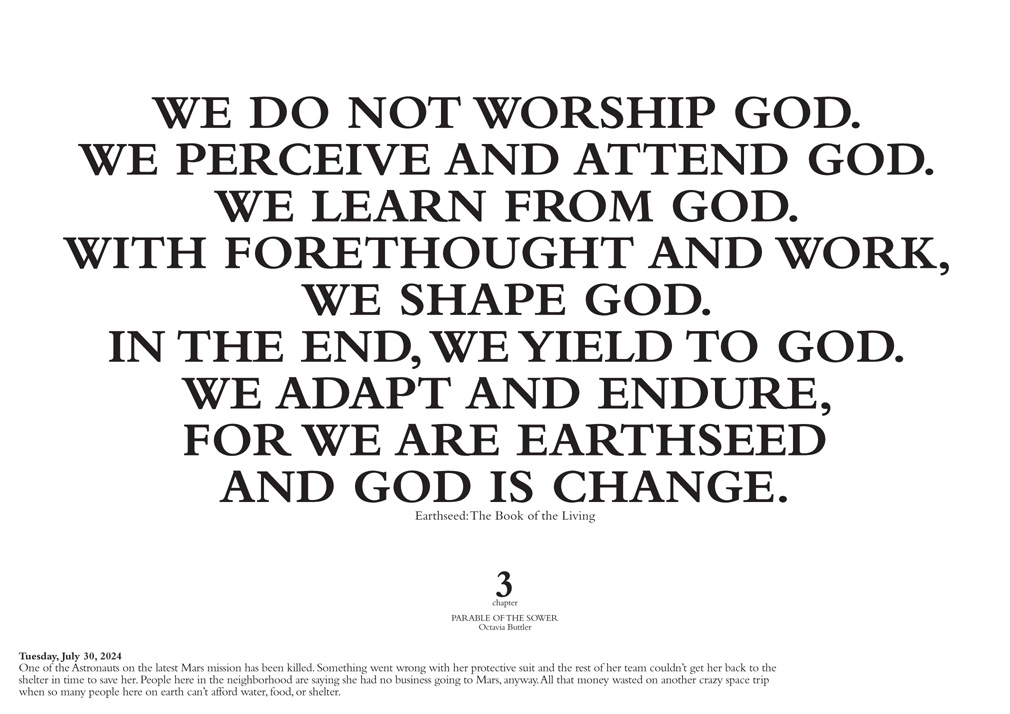
*Central to the novel is Lauren Olamina’s religion, Earthseed, which is based on the idea that “God is Change.”
Human beings shape God through their actions—we shape the future by what we do now.
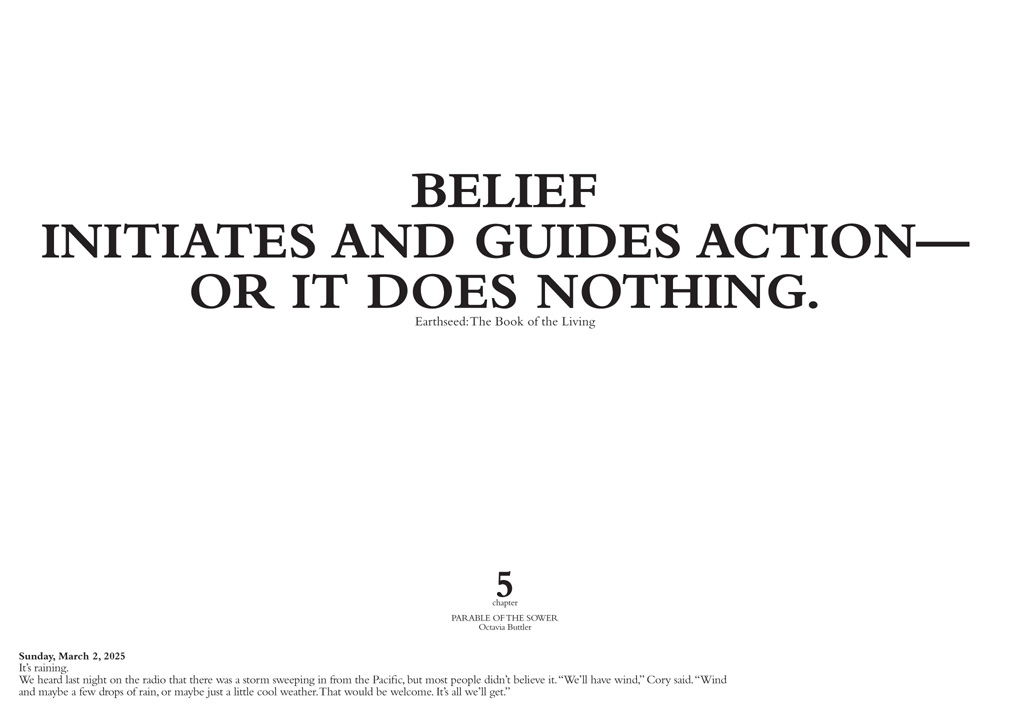
Her belief system is action-oriented, adaptive, and grounded in skills, knowledge, and resilience—tools to navigate life; there is no room for blind faith.
The novel emphasizes the importance of forming communities, teaching, and learning from one another. Life depends on cooperation, planning, and shared values.
They exist to emphasize respect for everything around you.
They exist to emphasize our communities.
They exist to engage both our minds and our bodies.
The Clergy: The Order of Continuance is the living memory of the world—to share is to continue;
to remember is to build.
Change is sacred; forgetting is dangerous.
They are the guardians of transmission. The Order ensures that knowledge—scientific, artistic, and cultural—flows unbroken across generations.
They secure what humanity has learned, adapting it for the next minds to build upon, honoring adaptation as sacred.
*Central to the novel is Lauren Olamina’s religion, Earthseed, which is based on the idea that “God is Change.”
Human beings shape God through their actions—we shape the future by what we do now.
Her belief system is action-oriented, adaptive, and grounded in skills, knowledge, and resilience—tools to navigate life; there is no room for blind faith.
The novel emphasizes the importance of forming communities, teaching, and learning from one another. Life depends on cooperation, planning, and shared values.
title
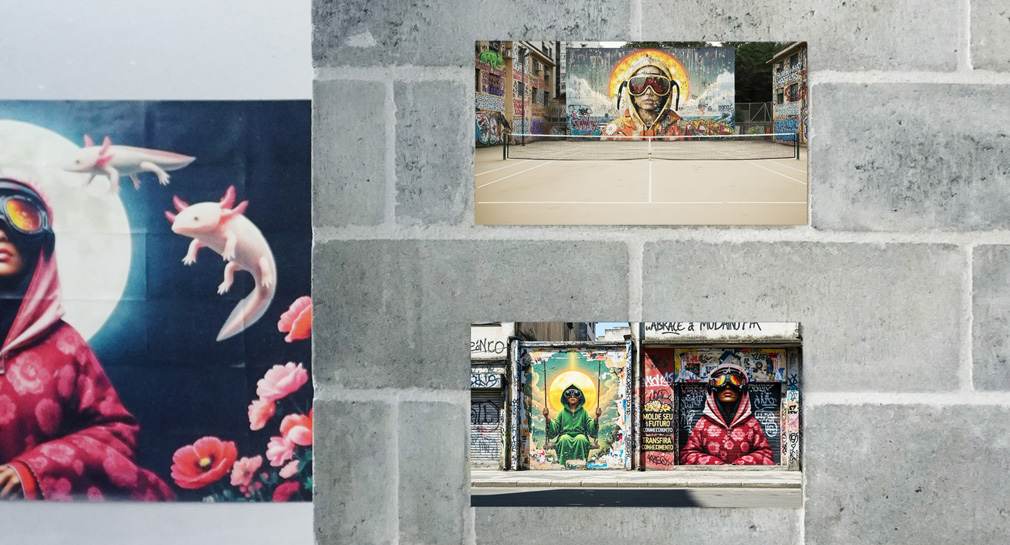
Earthkind – on the streets 1.2
info
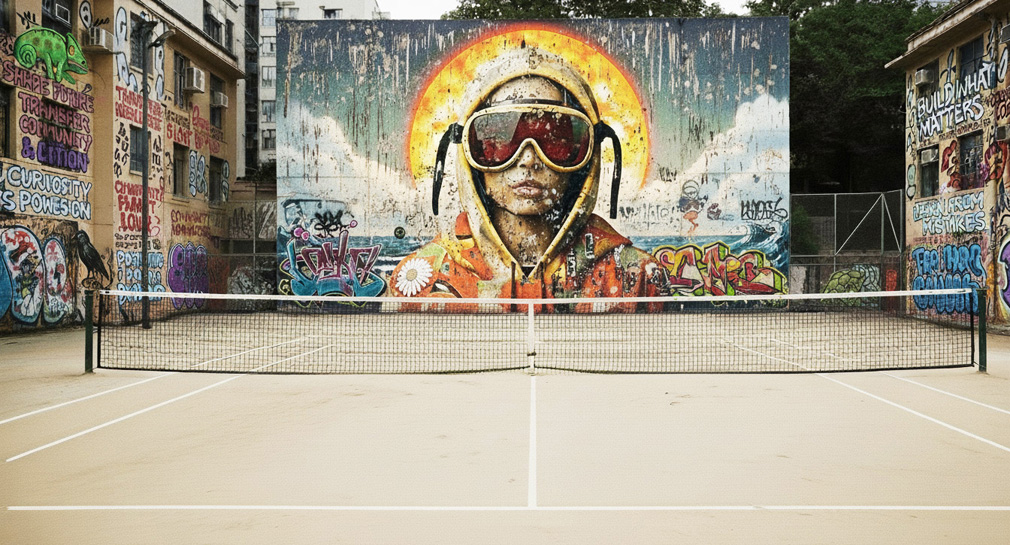
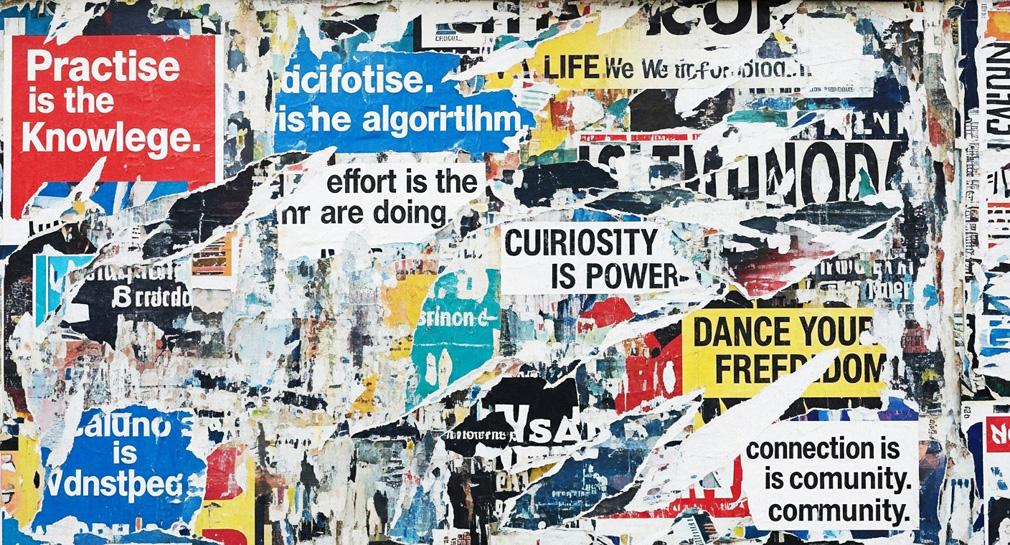
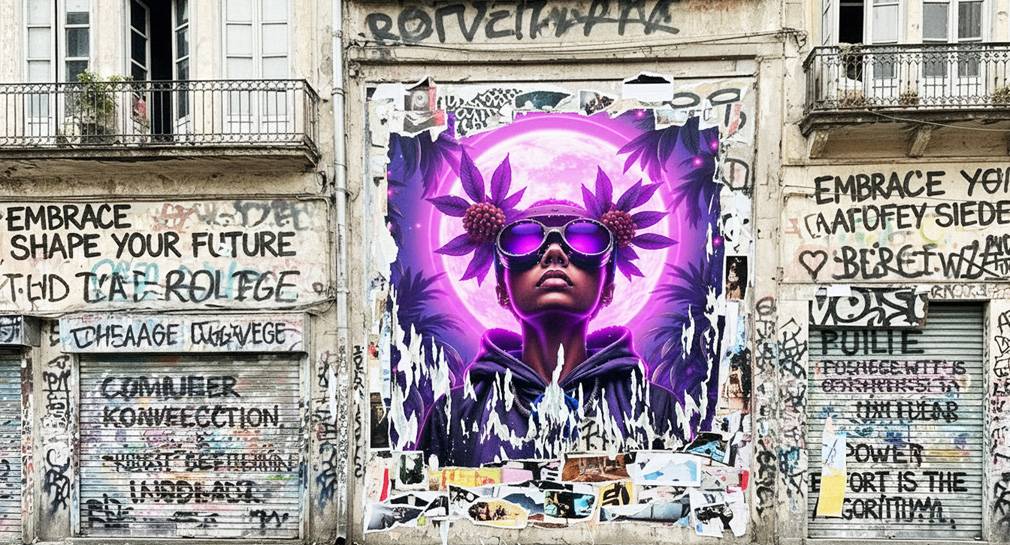
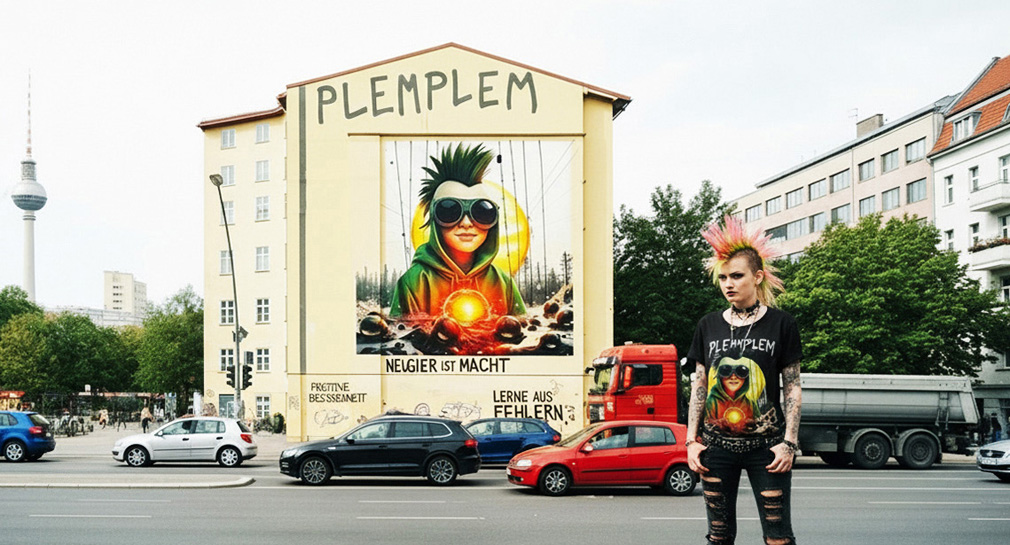
visualisations of the prophecy manifested through street art in public urban spaces



title
Spiritual Foundation – Octavia Buttler1.3
info
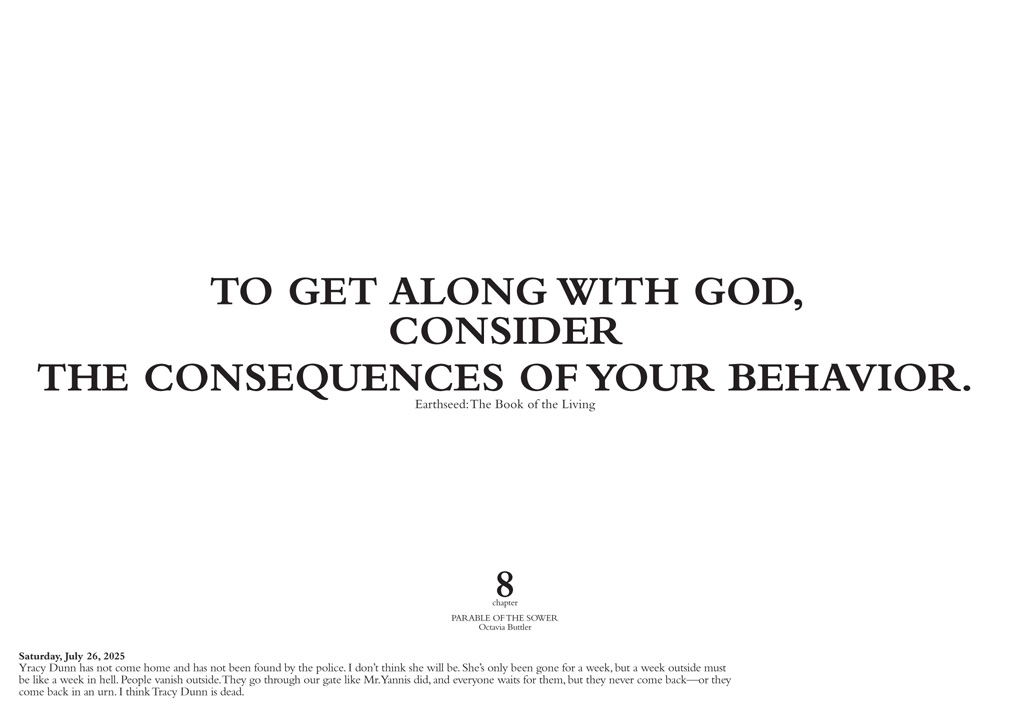
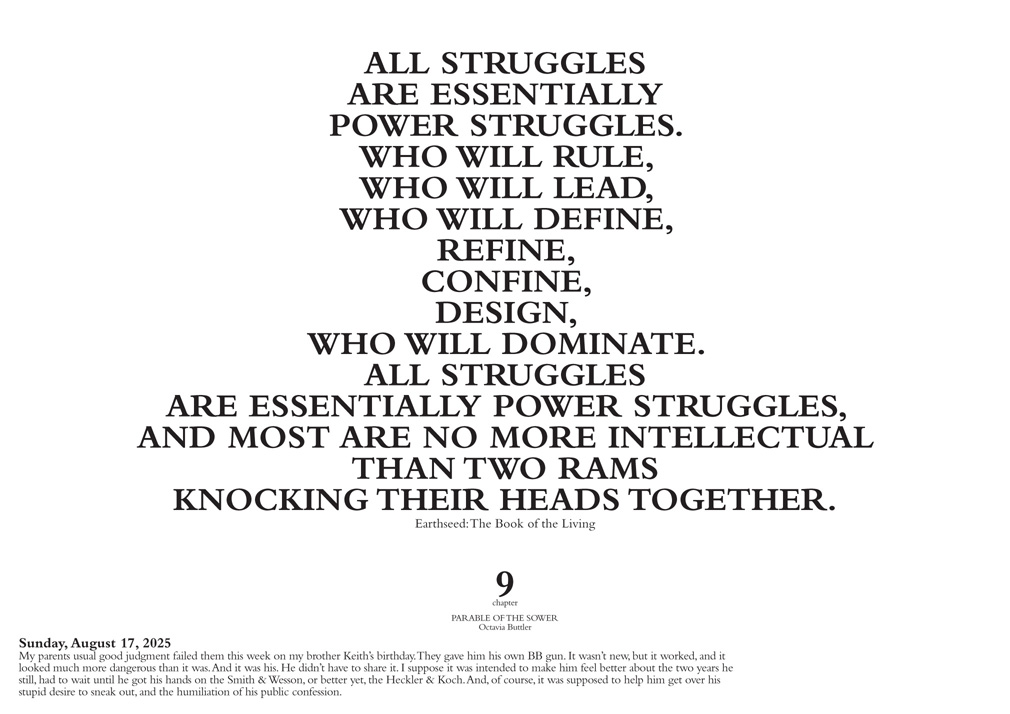
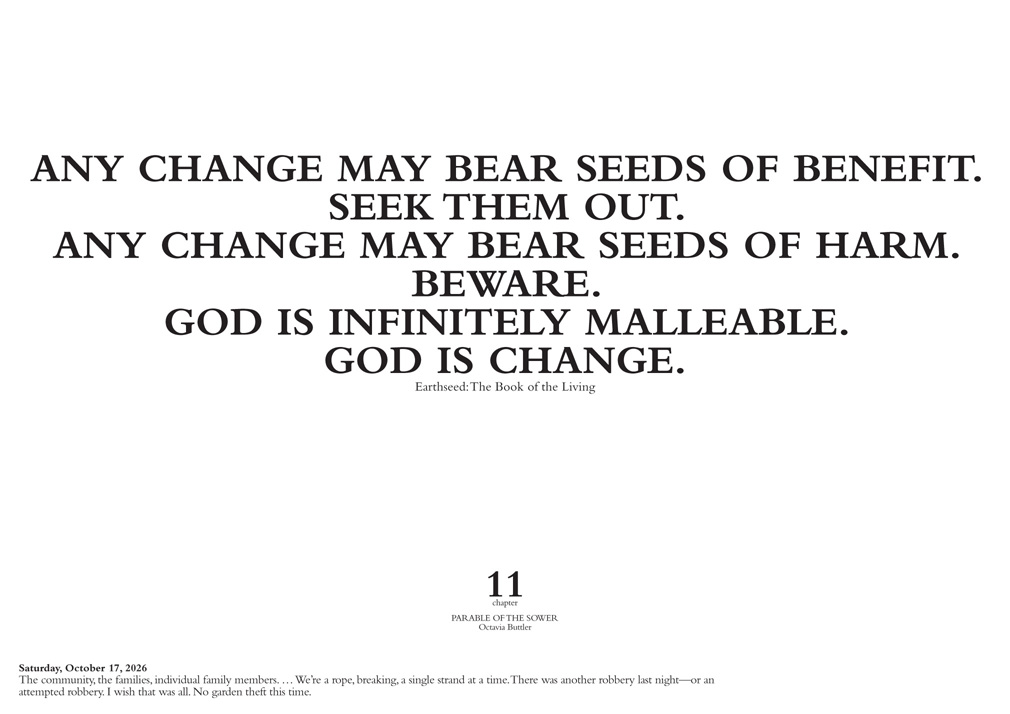
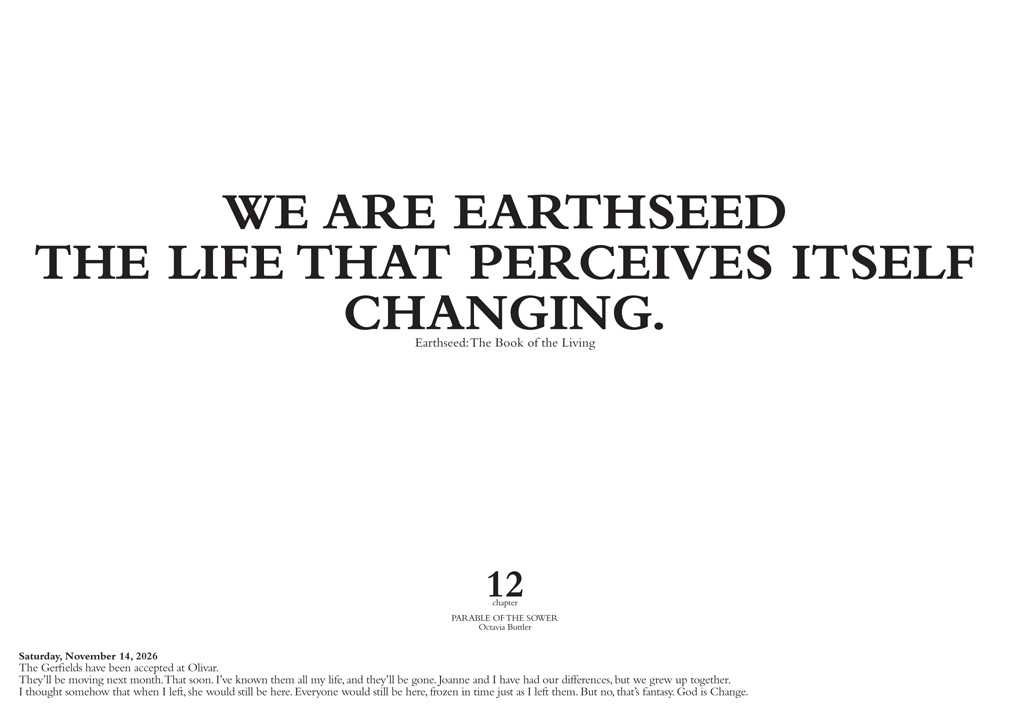
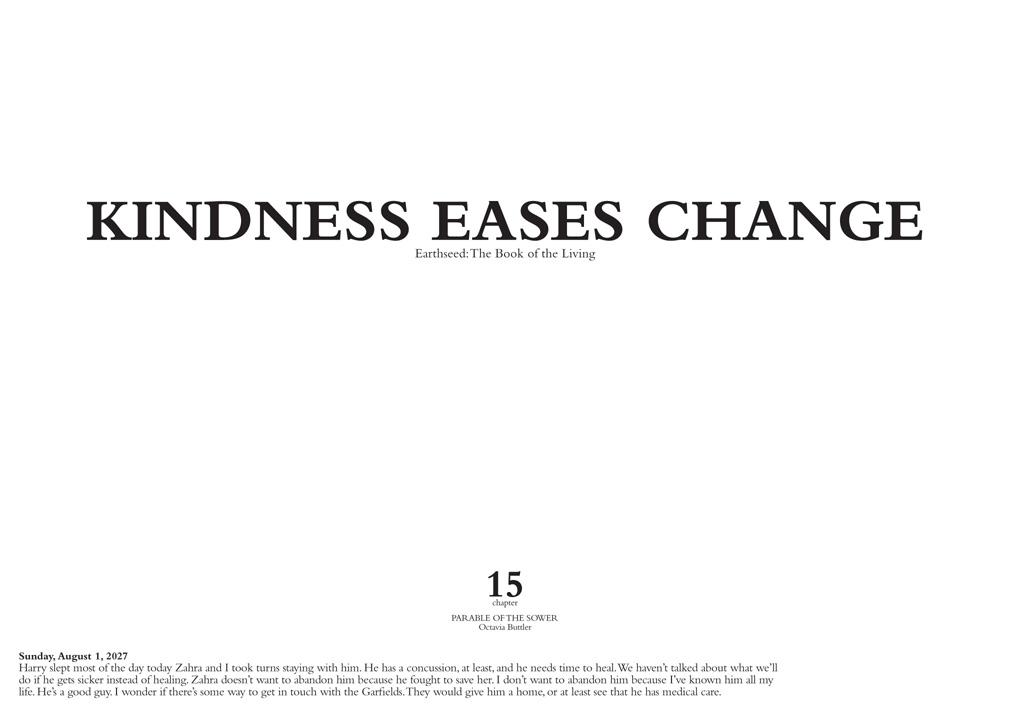
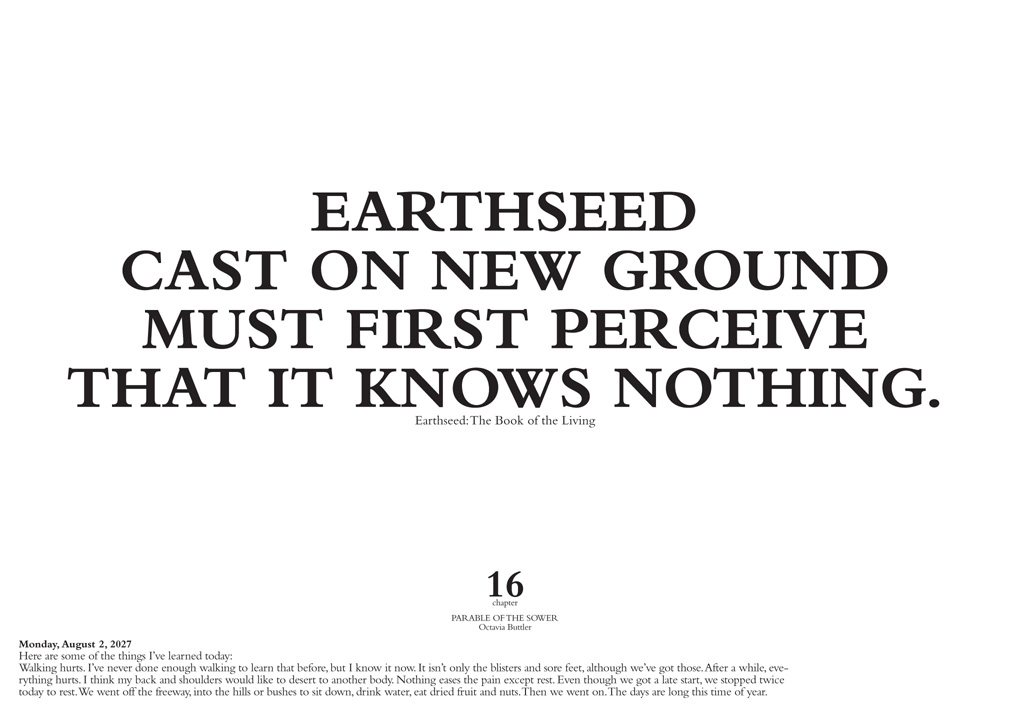
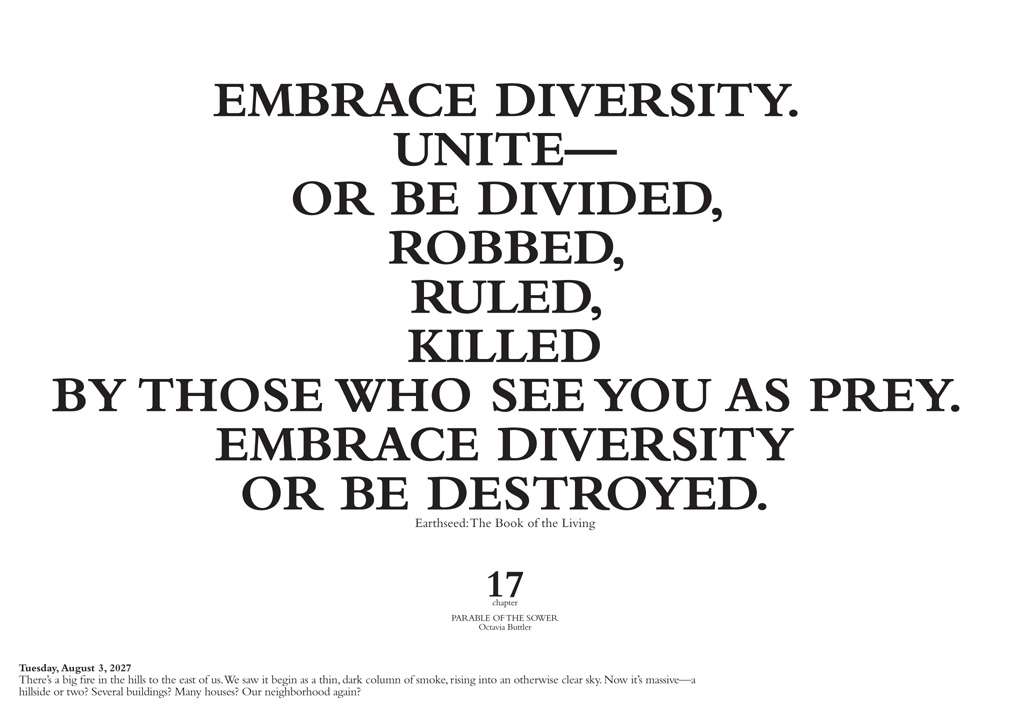
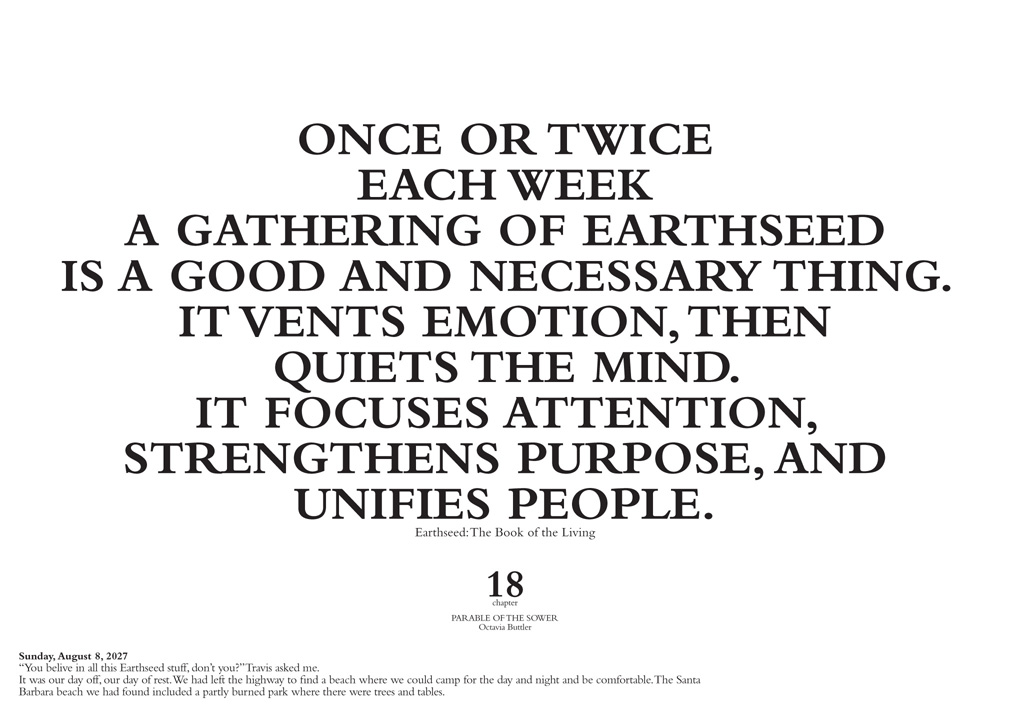
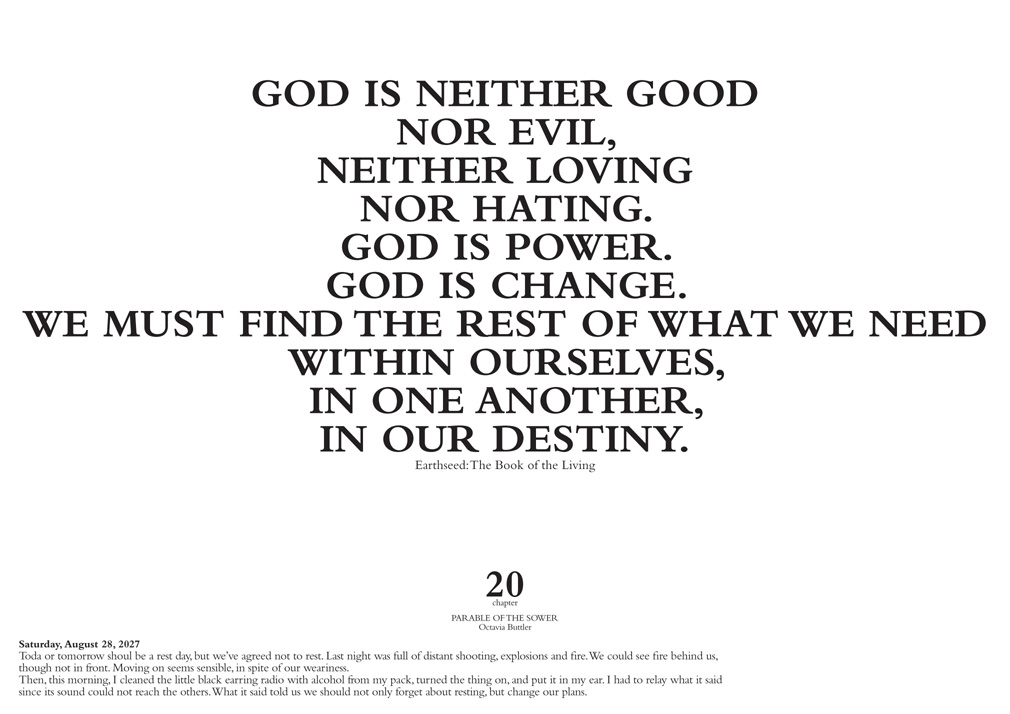
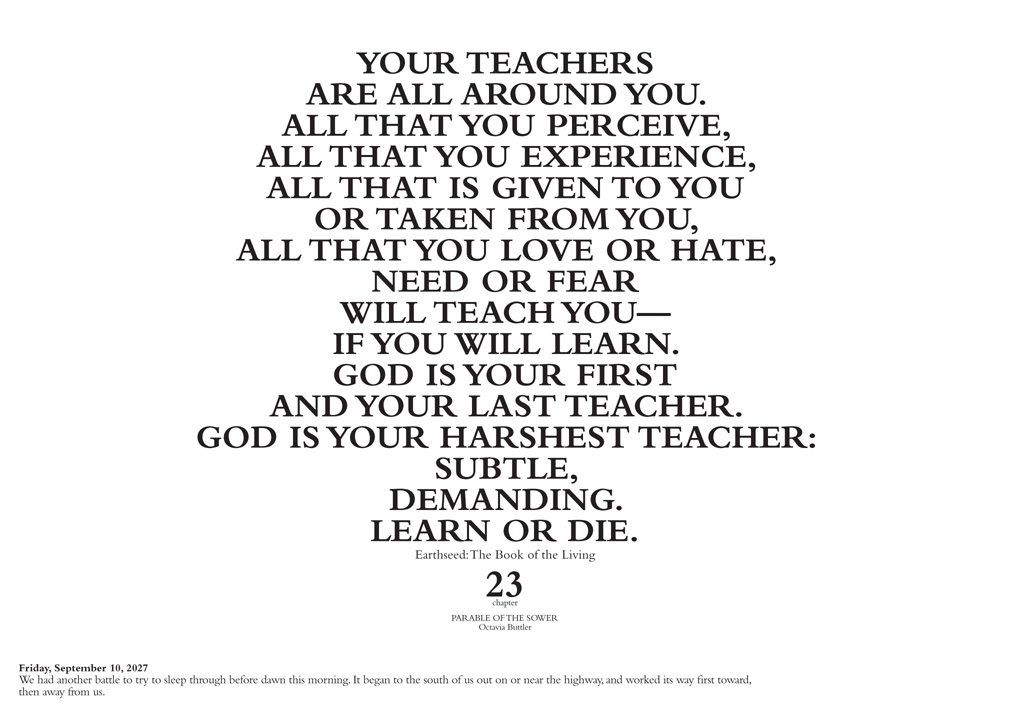
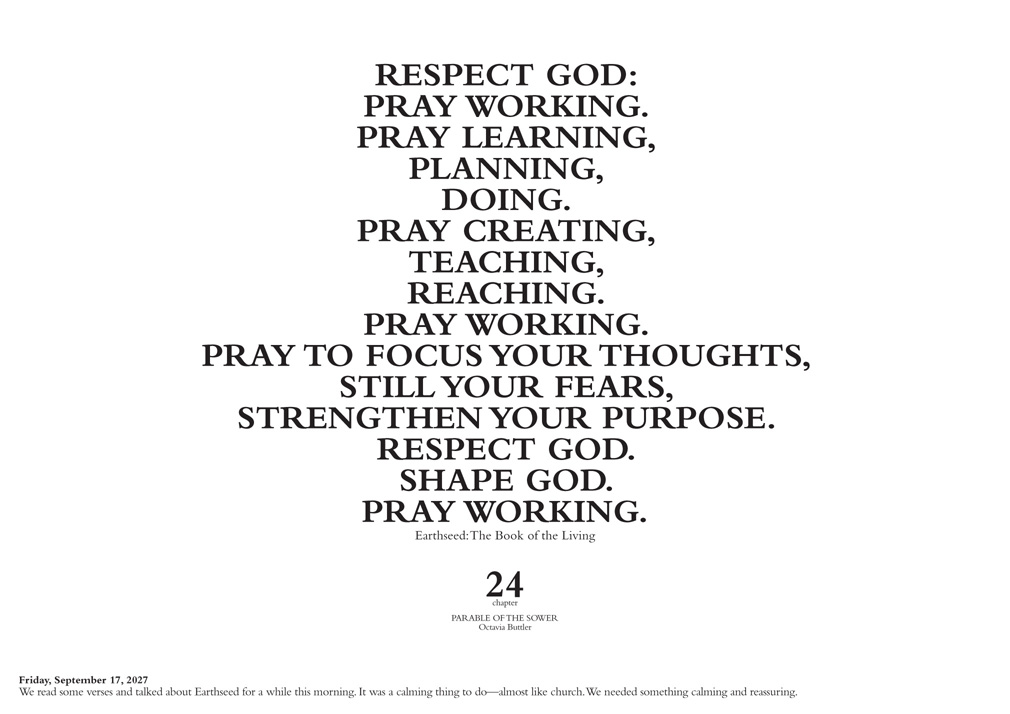
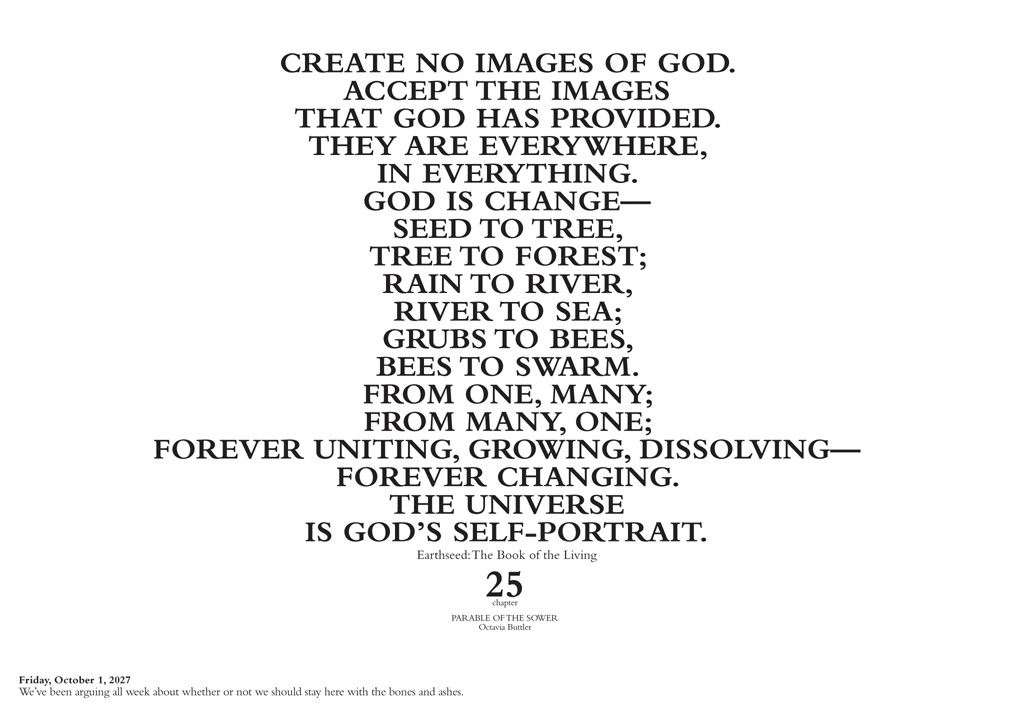
Octavia Buttler, Parable of the sower, 1993 – Chapters











title
Spiritual Cards / Guidelines 1.4
info
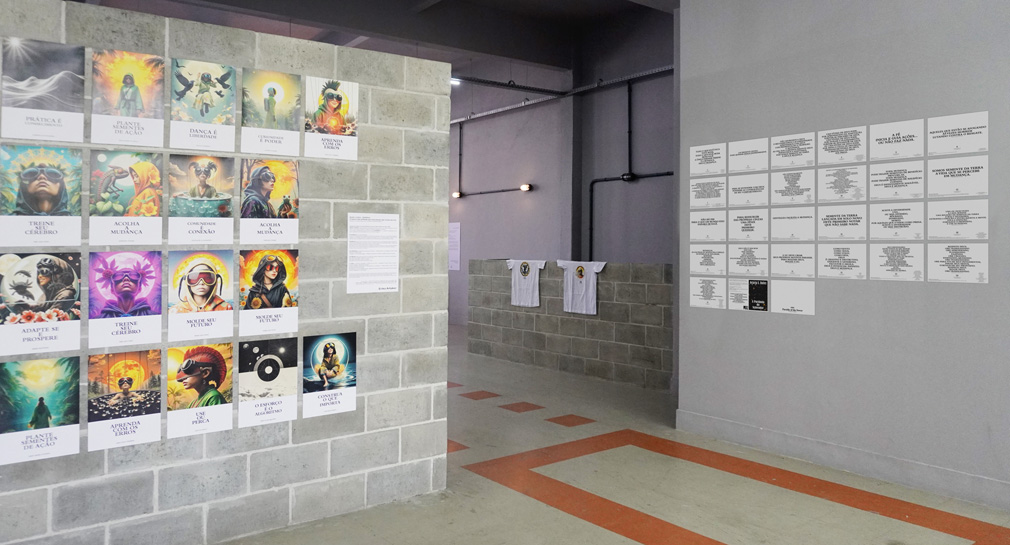
Earthkind – cards
























title
AI* – Auren Lumina – video 1.5
info
The Work of Art in the Age of Digital Production
3133 – AI images generated for Auren Lumina / Vídeo: 2’5’’ / 25fps
3133 – AI images generated for Auren Lumina / Vídeo: 2’5’’ / 25fps
The production: Images are generated through algorithms—a structured sequence of computational operations designed to learn from data, recognize patterns, and produce adaptive outputs.
The initial act of creation no longer requires deep mental envisioning or embodied making.
The workflow emphasizes iteration and batch processing, as the sheer volume of generated files stands in contrast to attentive, evolving creation.
Selection becomes the central task, relying on the ability to compare and curate images—an activity that remains detached from the act of creation itself (and can be offloaded to machines).
The initial act of creation no longer requires deep mental envisioning or embodied making.
The workflow emphasizes iteration and batch processing, as the sheer volume of generated files stands in contrast to attentive, evolving creation.
Selection becomes the central task, relying on the ability to compare and curate images—an activity that remains detached from the act of creation itself (and can be offloaded to machines).
The Tool: AI has the potential to be the greatest tool for understanding our material world—a partner in discovery, a magnifier of cognition. It does not merely process data;
it reveals hidden architectures of reality (e.g., protein folding, ...). It is a structure-revealing machine. Patterns emerge where previously there was only noise.
The same system that deepens understanding can also enable us to bypass it: when used solely as an engine of consumption and control, nature, time, and attention are simply fed into the machine. AI becomes a tool for efficiency, optimization, and convenience, replacing curiosity and embodiment.
The body and mind fade while the illusion of human intelligence expands.
Technology is never just a tool; it is a framework for thought.
Inventions such as language, fire, writing, the clock etc. frame human reality—they sculpt how and what we perceive, think, and act.
Just as language provides the words with which we think, each tool reorganizes thinking and action. The grammar of technology becomes the grammar of our culture.
A spreadsheet trains us to think in cells. A camera teaches us to see in frames.
An algorithm functions as a shortcut from structured thought to automated understanding.
There is no neutral tool.
The perception: The Image in the Digital Age is an exploration of perception under conditions of infinite generation and rapid reproduction. In this landscape, images are created algorithmically and endlessly.
What remains is the pure encounter with the visual, the unfolding of meaning through perception, narrative suggestion, and iconography.
The brain gets into a neuro-aesthetic loop.
The brain thinks it’s doing something, but it’s only reacting.
The digital image becomes a looping field of perception. Viewers are drawn into endless streams of generated visuals, each iteration marginally different yet functionally identical.
As Vilém Flusser posits, technical images create a second-order reality—a world mediated by algorithmic and programmable structures. The viewer encounters not the world itself, but curated, generated representations.
Jean Baudrillard’s concept of simulation is evident, as generated images replace the real with signs of the real; emotion, memory, and recognition emerge from patterns rather than lived experience.
Bernhard Stiegler’s critique of attention industrialization resonate: the rapid generation of images fragments cognition, producing stimulation without comprehension.
The prefrontal cortex is underutilized in such fast-switching environments. The body memory is underutilized in just visual stimulation.
Biological aspects:
• Dopaminergic Reward Systems
Every switch in the image—especially in high-intensity footage like sports—triggers dopamine micro-releases.
These momentary hits simulate pleasure or engagement, but without any real accomplishment.
The brain thinks it’s doing something, but it’s only reacting.
• Disembodied Stimulation vs. Embodied Cognition
In activities like reading or physical action cognition is embodied—the body and brain co-create meaning.
In contrast, screen-based visual input creates disembodied cognition. The brain becomes a passive receptor of light and sound patterns.
As Alva Noë argues, consciousness is not just in the brain—it is enacted through movement and bodily interaction.
• The prefrontal cortex, responsible for sustained attention and decision-making, is underutilized in such fast-switching environments.
The viewer becomes a passive receptor of fragmented content, unable to build a coherent model of either scene.
• Mirror neurons, often activated during own and observed motion are tricked into partial simulation.
The brain thinks it’s doing something active— but there is no physical engagement.
This is a false sense of embodiment, like phantom movement.
It’s visual processing without muscular feedback—a disembodied performance loop.
• Working memory is bypassed: the flickering is too fast to encode either video meaningfully.
This leads to illusory cognitive engagement—the sensation of learning or doing without long-term retention or comprehension. As seen in studies of multitasking and digital media use, this leads to cognitive fatigue, not knowledge.
In this context, digital images operate as pure phenomena of perception, untethered from the material, historical, or authorial conditions that traditionally shaped value.
Infinite reproducibility, accelerated creation, and algorithmic variation generate a new ecology of vision—one in which the viewer becomes both interpreter and participant, constructing significance in a space defined by circulation, perception, and iconographic resonance rather than origin.
*Artificial Intelligence
it reveals hidden architectures of reality (e.g., protein folding, ...). It is a structure-revealing machine. Patterns emerge where previously there was only noise.
The same system that deepens understanding can also enable us to bypass it: when used solely as an engine of consumption and control, nature, time, and attention are simply fed into the machine. AI becomes a tool for efficiency, optimization, and convenience, replacing curiosity and embodiment.
The body and mind fade while the illusion of human intelligence expands.
Technology is never just a tool; it is a framework for thought.
Inventions such as language, fire, writing, the clock etc. frame human reality—they sculpt how and what we perceive, think, and act.
Just as language provides the words with which we think, each tool reorganizes thinking and action. The grammar of technology becomes the grammar of our culture.
A spreadsheet trains us to think in cells. A camera teaches us to see in frames.
An algorithm functions as a shortcut from structured thought to automated understanding.
There is no neutral tool.
The perception: The Image in the Digital Age is an exploration of perception under conditions of infinite generation and rapid reproduction. In this landscape, images are created algorithmically and endlessly.
What remains is the pure encounter with the visual, the unfolding of meaning through perception, narrative suggestion, and iconography.
The brain gets into a neuro-aesthetic loop.
The brain thinks it’s doing something, but it’s only reacting.
The digital image becomes a looping field of perception. Viewers are drawn into endless streams of generated visuals, each iteration marginally different yet functionally identical.
As Vilém Flusser posits, technical images create a second-order reality—a world mediated by algorithmic and programmable structures. The viewer encounters not the world itself, but curated, generated representations.
Jean Baudrillard’s concept of simulation is evident, as generated images replace the real with signs of the real; emotion, memory, and recognition emerge from patterns rather than lived experience.
Bernhard Stiegler’s critique of attention industrialization resonate: the rapid generation of images fragments cognition, producing stimulation without comprehension.
The prefrontal cortex is underutilized in such fast-switching environments. The body memory is underutilized in just visual stimulation.
Biological aspects:
• Dopaminergic Reward Systems
Every switch in the image—especially in high-intensity footage like sports—triggers dopamine micro-releases.
These momentary hits simulate pleasure or engagement, but without any real accomplishment.
The brain thinks it’s doing something, but it’s only reacting.
• Disembodied Stimulation vs. Embodied Cognition
In activities like reading or physical action cognition is embodied—the body and brain co-create meaning.
In contrast, screen-based visual input creates disembodied cognition. The brain becomes a passive receptor of light and sound patterns.
As Alva Noë argues, consciousness is not just in the brain—it is enacted through movement and bodily interaction.
• The prefrontal cortex, responsible for sustained attention and decision-making, is underutilized in such fast-switching environments.
The viewer becomes a passive receptor of fragmented content, unable to build a coherent model of either scene.
• Mirror neurons, often activated during own and observed motion are tricked into partial simulation.
The brain thinks it’s doing something active— but there is no physical engagement.
This is a false sense of embodiment, like phantom movement.
It’s visual processing without muscular feedback—a disembodied performance loop.
• Working memory is bypassed: the flickering is too fast to encode either video meaningfully.
This leads to illusory cognitive engagement—the sensation of learning or doing without long-term retention or comprehension. As seen in studies of multitasking and digital media use, this leads to cognitive fatigue, not knowledge.
In this context, digital images operate as pure phenomena of perception, untethered from the material, historical, or authorial conditions that traditionally shaped value.
Infinite reproducibility, accelerated creation, and algorithmic variation generate a new ecology of vision—one in which the viewer becomes both interpreter and participant, constructing significance in a space defined by circulation, perception, and iconographic resonance rather than origin.
*Artificial Intelligence
title
Energy Flow INSTALATION – world 2023 1.6
info
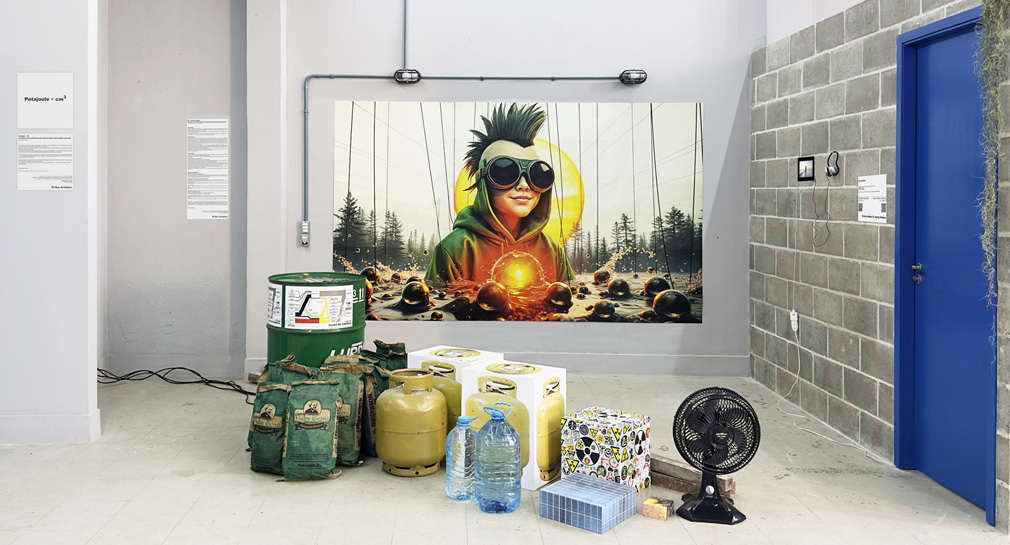
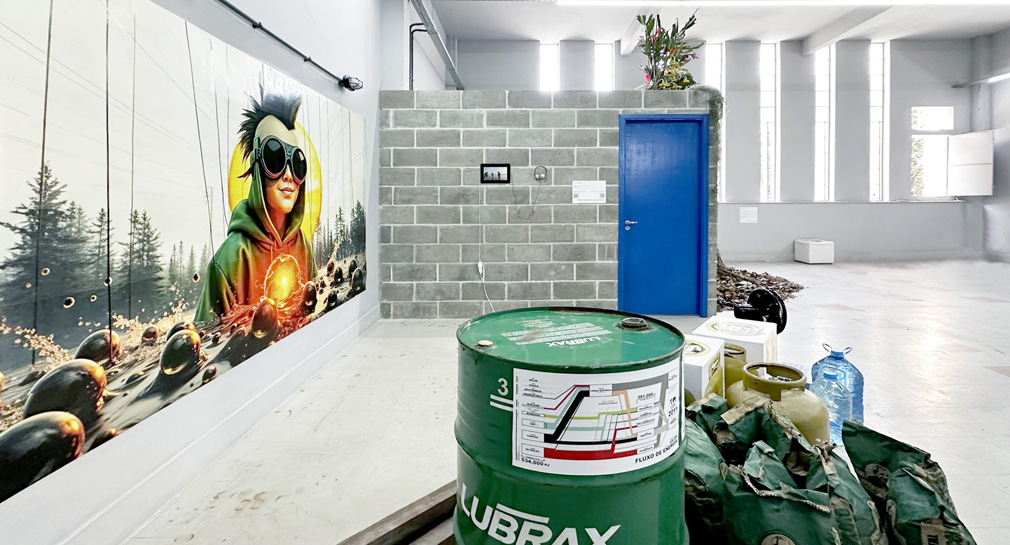
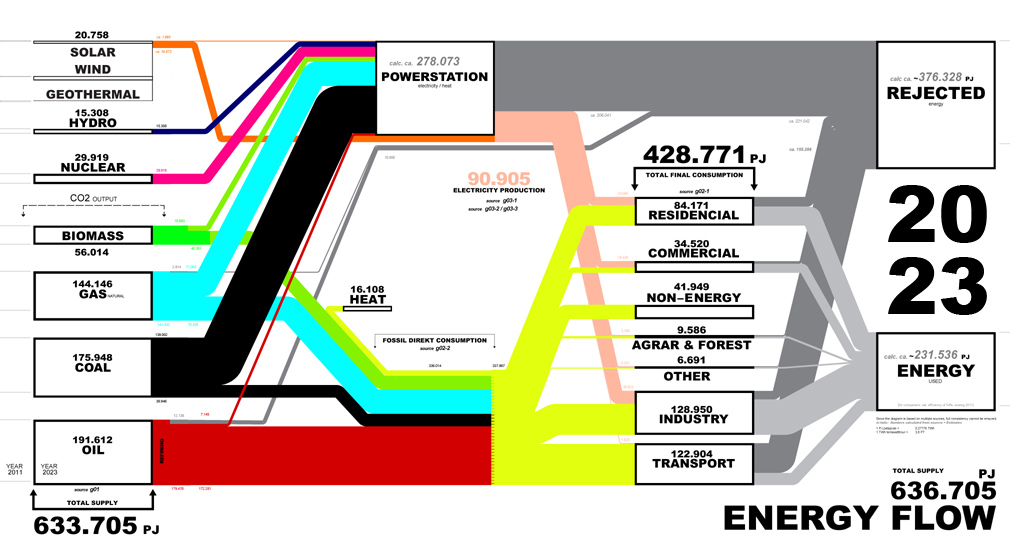
sculpture visualising the energy supply for the world in 2023
Energy – AI
The future is so bright you‘ve got to wear shades
Energy consumption
tion of images demands energy.
As human brainpower is offloaded onto machines, that energy too must be drawn from the Earth and the sun]
Between 2011 and 2023, statistics reveal a runaway rise in global energy consumption, requiring ever more land and resources from the planet.
The expansion of renewable energy has not kept pace with rising demand—let alone replaced the fossil fuels that release CO2 from carbon mostly stored between 250 and 66 million years ago.
That CO2 now lies over the atmosphere like a blanket, heating the planet and turning the oceans into acidic pools—beginning to end the pleasant conditions that made the rise of human culture, starting around 11,000 years ago (the end of the last ice age), possible.
We are exponentially extracting energy from the only place that sustains our life, in pursuit of a vaguely defined goal of expansion, optimization, and automation.
If we respect the limits set by physics, reduction is the possible—but seemingly impossible—way forward.
Petajoule ≡ cm3
1 PJ = 0,2778 TWh
The future is so bright you‘ve got to wear shades
Energy consumption
tion of images demands energy.
As human brainpower is offloaded onto machines, that energy too must be drawn from the Earth and the sun]
Between 2011 and 2023, statistics reveal a runaway rise in global energy consumption, requiring ever more land and resources from the planet.
The expansion of renewable energy has not kept pace with rising demand—let alone replaced the fossil fuels that release CO2 from carbon mostly stored between 250 and 66 million years ago.
That CO2 now lies over the atmosphere like a blanket, heating the planet and turning the oceans into acidic pools—beginning to end the pleasant conditions that made the rise of human culture, starting around 11,000 years ago (the end of the last ice age), possible.
We are exponentially extracting energy from the only place that sustains our life, in pursuit of a vaguely defined goal of expansion, optimization, and automation.
If we respect the limits set by physics, reduction is the possible—but seemingly impossible—way forward.
Petajoule ≡ cm3
1 PJ = 0,2778 TWh
title
Ai– spiritual objects 1.7
info
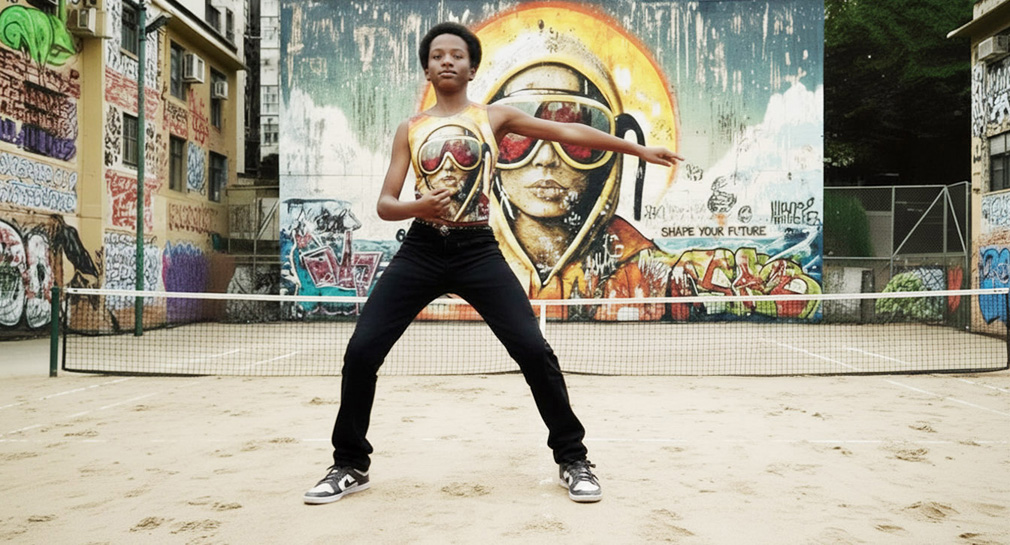
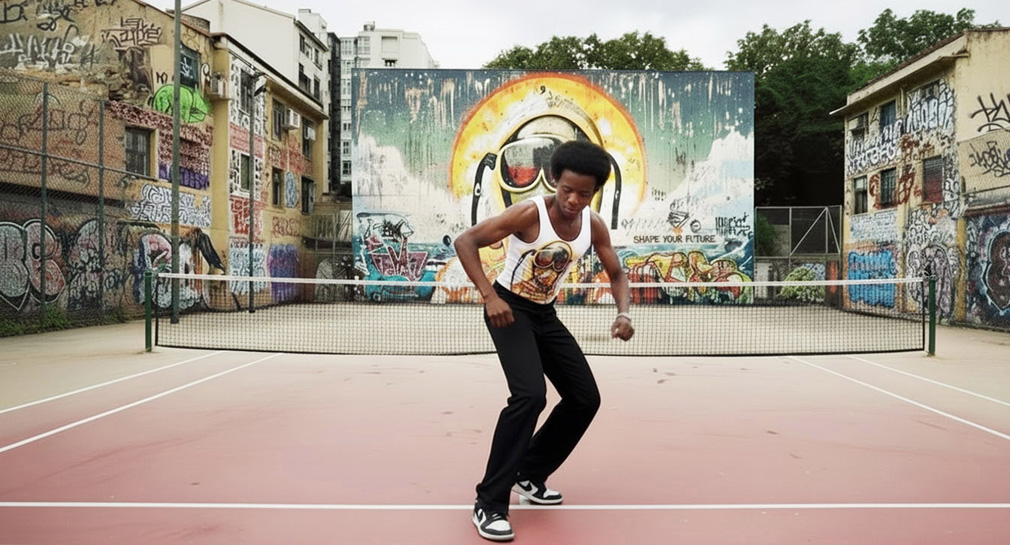
– T shirt









Exhibition
Eco Echo1.1 – 1.2
Translation
Futuregirl – Auren Lumina 1.1
Port / Br
Earthkind – Uma visão afirmativa do futuro, enraizada nas realidades planetárias
Auren Lumina – Earthkind
O futuro é tão brilhante que você precisa usar óculos escuros
Inspirado pelo sistema de crenças Earthseed de Octavia E. Butler (Parable of the Sower, 1993)*,
Auren Lumina incorpora a profecia e a expressão visual de uma nova fé, com o poder de projetar um futuro afirmativo e interconectado, enraizado em valores que sustentam o significado e a existência.
Auren torna-se o protagonista da fé em evolução denominada Earthkind — e— expandindo, reinterpretando e iluminando a essência do romance de Butler em um novo continuum visionário.
A mudança é o princípio fundamental
O tempo flui, a matéria se move e os sistemas se expandem e se desenvolvem. Movimento é o estado natural da existência.
Alinhar-se com a realidade é reconhecer que todas as coisas estão em fluxo, que nossa percepção, crescimento e compreensão surgem do engajamento em uma prática circular e equilibrada dentro dessa transformação contínua.
Earthkind projeta um futuro que afirma a vida em todas as suas formas, no qual imaginação, ação e crescimento humanos fluem em alinhamento com os ritmos da Terra — enquanto cada escolha reverbera pela biosfera, moldando não apenas a existência individual, mas também os sistemas vivos do planeta.
Ele imagina um futuro que se envolve de forma consciente, responsável e criativa com o mundo, honrando a interdependência de toda a vida, que está incorporada e é inseparável dos ciclos, fluxos e redes que sustentam a existência.
(O objetivo é um planeta próspero sob as estrelas.)
As Diretrizes de Earthkind são protocolos em evolução — princípios práticos que se adaptam conforme os seres humanos e o planeta mudam.
A linguagem é uma tecnologia sagrada — destinada a ser usada com consciência e respeito pelo poder que carrega.
O futuro é tão brilhante que você precisa usar óculos escuros
Inspirado pelo sistema de crenças Earthseed de Octavia E. Butler (Parable of the Sower, 1993)*,
Auren Lumina incorpora a profecia e a expressão visual de uma nova fé, com o poder de projetar um futuro afirmativo e interconectado, enraizado em valores que sustentam o significado e a existência.
Auren torna-se o protagonista da fé em evolução denominada Earthkind — e— expandindo, reinterpretando e iluminando a essência do romance de Butler em um novo continuum visionário.
A mudança é o princípio fundamental
O tempo flui, a matéria se move e os sistemas se expandem e se desenvolvem. Movimento é o estado natural da existência.
Alinhar-se com a realidade é reconhecer que todas as coisas estão em fluxo, que nossa percepção, crescimento e compreensão surgem do engajamento em uma prática circular e equilibrada dentro dessa transformação contínua.
Earthkind projeta um futuro que afirma a vida em todas as suas formas, no qual imaginação, ação e crescimento humanos fluem em alinhamento com os ritmos da Terra — enquanto cada escolha reverbera pela biosfera, moldando não apenas a existência individual, mas também os sistemas vivos do planeta.
Ele imagina um futuro que se envolve de forma consciente, responsável e criativa com o mundo, honrando a interdependência de toda a vida, que está incorporada e é inseparável dos ciclos, fluxos e redes que sustentam a existência.
(O objetivo é um planeta próspero sob as estrelas.)
As Diretrizes de Earthkind são protocolos em evolução — princípios práticos que se adaptam conforme os seres humanos e o planeta mudam.
A linguagem é uma tecnologia sagrada — destinada a ser usada com consciência e respeito pelo poder que carrega.
abrace a mudança
molde seu futuro
transfira conhecimento
a comunidade é conexão
plante sementes de ação
construa o que importa
obsessão positiva
a curiosidade é poder
a dança é liberdade
adquirir, analisar, adaptar
aprenda com os erros
adapte se e prospere
treine seu cérebro
use-o ou perca-o
a prática é conhecimento
o esforço é o algoritmo
molde seu futuro
transfira conhecimento
a comunidade é conexão
plante sementes de ação
construa o que importa
obsessão positiva
a curiosidade é poder
a dança é liberdade
adquirir, analisar, adaptar
aprenda com os erros
adapte se e prospere
treine seu cérebro
use-o ou perca-o
a prática é conhecimento
o esforço é o algoritmo
Os Rituais existem para proporcionar uma existência enraizada e próspera dentro da estrutura do nosso planeta.
Eles existem para enfatizar o respeito por tudo ao seu redor.
Eles existem para enfatizar nossas comunidades.
Eles existem para envolver tanto a mente quanto o corpo.
O Clero: A Ordem da Continuidade é a memória viva do mundo — compartilhar é continuar; lembrar é construir. A mudança é sagrada; o esquecimento é perigoso.
Eles são os guardiões da transmissão. A Ordem garante que o conhecimento — científico, artístico e cultural — flua ininterruptamente através das gerações.
Eles asseguram o que a humanidade aprendeu, adaptando-o para que as próximas mentes possam construir sobre ele, honrando a adaptação como algo sagrado.
*Central para o romance está a religião de Lauren Olamina, Earthseed, baseada na ideia de que “Deus é Mudança.”
Os seres humanos moldam Deus através de suas ações — moldamos o futuro pelo que fazemos agora.
Seu sistema de crenças é orientado à ação, adaptativo e fundamentado em habilidades, conhecimento e resiliência — ferramentas para navegar pela vida; não há espaço para fé cega.
O romance enfatiza a importância de formar comunidades, ensinar e aprender uns com os outros. A vida depende de cooperação, planejamento e valores compartilhados.
Eles existem para enfatizar o respeito por tudo ao seu redor.
Eles existem para enfatizar nossas comunidades.
Eles existem para envolver tanto a mente quanto o corpo.
O Clero: A Ordem da Continuidade é a memória viva do mundo — compartilhar é continuar; lembrar é construir. A mudança é sagrada; o esquecimento é perigoso.
Eles são os guardiões da transmissão. A Ordem garante que o conhecimento — científico, artístico e cultural — flua ininterruptamente através das gerações.
Eles asseguram o que a humanidade aprendeu, adaptando-o para que as próximas mentes possam construir sobre ele, honrando a adaptação como algo sagrado.
*Central para o romance está a religião de Lauren Olamina, Earthseed, baseada na ideia de que “Deus é Mudança.”
Os seres humanos moldam Deus através de suas ações — moldamos o futuro pelo que fazemos agora.
Seu sistema de crenças é orientado à ação, adaptativo e fundamentado em habilidades, conhecimento e resiliência — ferramentas para navegar pela vida; não há espaço para fé cega.
O romance enfatiza a importância de formar comunidades, ensinar e aprender uns com os outros. A vida depende de cooperação, planejamento e valores compartilhados.
Translation
AI* – Auren Lumina – video 1.5
Port / Br
A Obra de Arte na Era da Produção Digital
A produção:
As imagens são geradas por algoritmos — uma sequência estruturada de operações computacionais projetada para aprender com dados, reconhecer padrões e produzir resultados adaptativos.
O ato inicial de criação não exige mais uma profunda visualização mental ou um fazer incorporado.
O fluxo de trabalho enfatiza a iteração e o processamento em lote, pois o enorme volume de arquivos gerados contrasta com a criação atenta e evolutiva.
A seleção torna-se a tarefa central, dependente da capacidade de comparar e curar imagens — uma atividade que permanece distante do ato de criação em si (e que pode ser delegada às máquinas).
A Ferramenta:
A IA tem o potencial de ser a maior ferramenta para compreender o nosso mundo material — uma parceira na descoberta, um ampliador da cognição.
Ela não apenas processa dados; revela arquiteturas ocultas da realidade (por exemplo, dobramento de proteínas). É uma máquina reveladora de estruturas.
Padrões emergem onde antes havia apenas ruído.
O mesmo sistema que aprofunda a compreensão também pode nos permitir evitá-la:
quando usada apenas como motor de consumo e controle, natureza, tempo e atenção tornam-se alimento para a máquina.
A IA torna-se uma ferramenta de eficiência, otimização e conveniência, substituindo curiosidade e corporeidade.
Corpo e mente se apagam enquanto a ilusão da inteligência humana se expande.
A tecnologia nunca é apenas uma ferramenta; é uma moldura para o pensamento.
Invenções como a linguagem, o fogo, a escrita, o relógio etc. moldam a realidade humana — esculpem como e o que percebemos, pensamos e fazemos.
Assim como a linguagem fornece as palavras com as quais pensamos, cada ferramenta reorganiza o pensamento e a ação.
A gramática da tecnologia torna-se a gramática de nossa cultura.
Uma planilha nos treina a pensar em células.
Uma câmera nos ensina a ver em quadros. Um algoritmo funciona como um atalho entre o pensamento estruturado e a compreensão automatizada.
Não existe ferramenta neutra.
A percepção:
A Imagem na Era Digital é uma exploração da percepção sob condições de geração infinita e reprodução acelerada. Nesse cenário, imagens são criadas de forma algorítmica e incessante.
O que resta é o encontro puro com o visual, o desdobrar de significado por meio da percepção, da sugestão narrativa e da iconografia.
O cérebro entra em um loop neuroestético.
O cérebro acha que está fazendo algo, mas está apenas reagindo.
A imagem digital torna-se um campo de percepção em looping. Espectadores são atraídos para fluxos intermináveis de visuais gerados, cada iteração marginalmente diferente, porém funcionalmente idêntica.
Como Vilém Flusser afirma, as imagens técnicas criam uma realidade de segunda ordem — um mundo mediado por estruturas algorítmicas e programáveis.
O espectador encontra não o mundo em si, mas representações geradas e curadas.
O conceito de simulação de Jean Baudrillard se torna evidente, à medida que imagens geradas substituem o real por signos do real; emoção, memória e reconhecimento emergem de padrões, não de experiência vivida.
As críticas de Bernhard Stiegler à industrialização da atenção ressoam: a geração acelerada de imagens fragmenta a cognição, produzindo estimulação sem compreensão.
O córtex pré-frontal é subutilizado em ambientes de trocas rápidas. A memória corporal é subutilizada em mera estimulação visual.
Aspectos biológicos:
• Sistemas de Recompensa Dopaminérgicos Cada mudança na imagem — especialmente em vídeos de alta intensidade, como esportes — desencadeia micro-liberamentos de dopamina.
Esses picos momentâneos simulam prazer ou engajamento, mas sem qualquer realização real.
O cérebro acha que está fazendo algo, mas está apenas reagindo.
• Estimulação Desincorporada vs. Cognição Incorporada Em atividades como leitura ou ação física, a cognição é incorporada — corpo e cérebro co-criam significado.
Em contraste, o input visual baseado em telas cria cognição desincorporada. O cérebro torna-se um receptor passivo de padrões de luz e som.
Como argumenta Alva Noë, a consciência não está apenas no cérebro — ela é encenada através do movimento e da interação corporal.
• O córtex pré-frontal, responsável por atenção sustentada e tomada de decisão, é subutilizado em ambientes de troca rápida.
O espectador torna-se um receptor passivo de conteúdo fragmentado, incapaz de construir um modelo coerente de qualquer cena.
• Os neurônios-espelho, frequentemente ativados durante o próprio movimento ou a observação de movimento, são enganados em uma simulação parcial.
O cérebro acredita estar fazendo algo ativo — mas não há engajamento físico.
É uma falsa sensação de incorporação, como movimento fantasma.
• A memória de trabalho é contornada: o piscar é rápido demais para codificar qualquer vídeo de forma significativa. Isso leva a um engajamento cognitivo ilusório — a sensação de aprender ou fazer algo sem retenção ou compreensão a longo prazo.
Como visto em estudos sobre multitarefa e uso de mídia digital, isso resulta em fadiga cognitiva, não em conhecimento.
Nesse contexto, as imagens digitais operam como fenômenos puros de percepção, desvinculadas das condições materiais, históricas ou autorais que tradicionalmente moldavam valor.
Reprodutibilidade infinita, criação acelerada e variação algorítmica geram uma nova ecologia da visão — uma em que o espectador se torna tanto intérprete quanto participante, construindo significado em um espaço definido por circulação, percepção e ressonância iconográfica, em vez de origem.
*Inteligência Artificial
As imagens são geradas por algoritmos — uma sequência estruturada de operações computacionais projetada para aprender com dados, reconhecer padrões e produzir resultados adaptativos.
O ato inicial de criação não exige mais uma profunda visualização mental ou um fazer incorporado.
O fluxo de trabalho enfatiza a iteração e o processamento em lote, pois o enorme volume de arquivos gerados contrasta com a criação atenta e evolutiva.
A seleção torna-se a tarefa central, dependente da capacidade de comparar e curar imagens — uma atividade que permanece distante do ato de criação em si (e que pode ser delegada às máquinas).
A Ferramenta:
A IA tem o potencial de ser a maior ferramenta para compreender o nosso mundo material — uma parceira na descoberta, um ampliador da cognição.
Ela não apenas processa dados; revela arquiteturas ocultas da realidade (por exemplo, dobramento de proteínas). É uma máquina reveladora de estruturas.
Padrões emergem onde antes havia apenas ruído.
O mesmo sistema que aprofunda a compreensão também pode nos permitir evitá-la:
quando usada apenas como motor de consumo e controle, natureza, tempo e atenção tornam-se alimento para a máquina.
A IA torna-se uma ferramenta de eficiência, otimização e conveniência, substituindo curiosidade e corporeidade.
Corpo e mente se apagam enquanto a ilusão da inteligência humana se expande.
A tecnologia nunca é apenas uma ferramenta; é uma moldura para o pensamento.
Invenções como a linguagem, o fogo, a escrita, o relógio etc. moldam a realidade humana — esculpem como e o que percebemos, pensamos e fazemos.
Assim como a linguagem fornece as palavras com as quais pensamos, cada ferramenta reorganiza o pensamento e a ação.
A gramática da tecnologia torna-se a gramática de nossa cultura.
Uma planilha nos treina a pensar em células.
Uma câmera nos ensina a ver em quadros. Um algoritmo funciona como um atalho entre o pensamento estruturado e a compreensão automatizada.
Não existe ferramenta neutra.
A percepção:
A Imagem na Era Digital é uma exploração da percepção sob condições de geração infinita e reprodução acelerada. Nesse cenário, imagens são criadas de forma algorítmica e incessante.
O que resta é o encontro puro com o visual, o desdobrar de significado por meio da percepção, da sugestão narrativa e da iconografia.
O cérebro entra em um loop neuroestético.
O cérebro acha que está fazendo algo, mas está apenas reagindo.
A imagem digital torna-se um campo de percepção em looping. Espectadores são atraídos para fluxos intermináveis de visuais gerados, cada iteração marginalmente diferente, porém funcionalmente idêntica.
Como Vilém Flusser afirma, as imagens técnicas criam uma realidade de segunda ordem — um mundo mediado por estruturas algorítmicas e programáveis.
O espectador encontra não o mundo em si, mas representações geradas e curadas.
O conceito de simulação de Jean Baudrillard se torna evidente, à medida que imagens geradas substituem o real por signos do real; emoção, memória e reconhecimento emergem de padrões, não de experiência vivida.
As críticas de Bernhard Stiegler à industrialização da atenção ressoam: a geração acelerada de imagens fragmenta a cognição, produzindo estimulação sem compreensão.
O córtex pré-frontal é subutilizado em ambientes de trocas rápidas. A memória corporal é subutilizada em mera estimulação visual.
Aspectos biológicos:
• Sistemas de Recompensa Dopaminérgicos Cada mudança na imagem — especialmente em vídeos de alta intensidade, como esportes — desencadeia micro-liberamentos de dopamina.
Esses picos momentâneos simulam prazer ou engajamento, mas sem qualquer realização real.
O cérebro acha que está fazendo algo, mas está apenas reagindo.
• Estimulação Desincorporada vs. Cognição Incorporada Em atividades como leitura ou ação física, a cognição é incorporada — corpo e cérebro co-criam significado.
Em contraste, o input visual baseado em telas cria cognição desincorporada. O cérebro torna-se um receptor passivo de padrões de luz e som.
Como argumenta Alva Noë, a consciência não está apenas no cérebro — ela é encenada através do movimento e da interação corporal.
• O córtex pré-frontal, responsável por atenção sustentada e tomada de decisão, é subutilizado em ambientes de troca rápida.
O espectador torna-se um receptor passivo de conteúdo fragmentado, incapaz de construir um modelo coerente de qualquer cena.
• Os neurônios-espelho, frequentemente ativados durante o próprio movimento ou a observação de movimento, são enganados em uma simulação parcial.
O cérebro acredita estar fazendo algo ativo — mas não há engajamento físico.
É uma falsa sensação de incorporação, como movimento fantasma.
• A memória de trabalho é contornada: o piscar é rápido demais para codificar qualquer vídeo de forma significativa. Isso leva a um engajamento cognitivo ilusório — a sensação de aprender ou fazer algo sem retenção ou compreensão a longo prazo.
Como visto em estudos sobre multitarefa e uso de mídia digital, isso resulta em fadiga cognitiva, não em conhecimento.
Nesse contexto, as imagens digitais operam como fenômenos puros de percepção, desvinculadas das condições materiais, históricas ou autorais que tradicionalmente moldavam valor.
Reprodutibilidade infinita, criação acelerada e variação algorítmica geram uma nova ecologia da visão — uma em que o espectador se torna tanto intérprete quanto participante, construindo significado em um espaço definido por circulação, percepção e ressonância iconográfica, em vez de origem.
*Inteligência Artificial
Translation
Energy Flow INSTALATION – world 2023 1.1
Port / Br
Escultura que visualiza o fornecimento de energia para o mundo em 2023
Consumo de energia
A produção em massa de imagens exige energia. À medida que o poder cognitivo humano é transferido para as máquinas, essa energia também precisa ser extraída da Terra e do sol.
Entre 2011 e 2023, as estatísticas revelam um aumento descontrolado no consumo global de energia, exigindo cada vez mais terras e recursos do planeta.
A expansão das energias renováveis não acompanhou o crescimento da demanda — muito menos substituiu os combustíveis fósseis que liberam CO2 acumulado principalmente entre 250 e 66 milhões de anos atrás.
Esse CO2 agora paira sobre a atmosfera como um cobertor, aquecendo o planeta e tornando os oceanos piscinas ácidas — iniciando o fim das condições agradáveis que permitiram o surgimento da cultura humana, por volta de 11.000 anos atrás (o fim da última era do gelo).
Estamos extraindo energia de forma exponencial do único lugar que sustenta nossa vida, em busca de um objetivo vagamente definido de expansão, otimização e automação.
Se respeitarmos os limites impostos pela física, a redução é o caminho possível — porém aparentemente impossível — daqui para frente.
*Inteligência Artificial
A produção em massa de imagens exige energia. À medida que o poder cognitivo humano é transferido para as máquinas, essa energia também precisa ser extraída da Terra e do sol.
Entre 2011 e 2023, as estatísticas revelam um aumento descontrolado no consumo global de energia, exigindo cada vez mais terras e recursos do planeta.
A expansão das energias renováveis não acompanhou o crescimento da demanda — muito menos substituiu os combustíveis fósseis que liberam CO2 acumulado principalmente entre 250 e 66 milhões de anos atrás.
Esse CO2 agora paira sobre a atmosfera como um cobertor, aquecendo o planeta e tornando os oceanos piscinas ácidas — iniciando o fim das condições agradáveis que permitiram o surgimento da cultura humana, por volta de 11.000 anos atrás (o fim da última era do gelo).
Estamos extraindo energia de forma exponencial do único lugar que sustenta nossa vida, em busca de um objetivo vagamente definido de expansão, otimização e automação.
Se respeitarmos os limites impostos pela física, a redução é o caminho possível — porém aparentemente impossível — daqui para frente.
*Inteligência Artificial
Translation
Guidelines 1.1
EN
Guidelines
embrace change
shape your future
transfer knowledge
community is connection
plant seeds of action
build what matters
positive obsession
curiosity is power
dance is freedom
aquire analyse adapt
learn from mistakes
adapt and thrive
train your brain
use it or lose it
practice is knowledge
effort is the algorithm
shape your future
transfer knowledge
community is connection
plant seeds of action
build what matters
positive obsession
curiosity is power
dance is freedom
aquire analyse adapt
learn from mistakes
adapt and thrive
train your brain
use it or lose it
practice is knowledge
effort is the algorithm
CH
灵性准则 (língxìng zhǔnzé)
拥抱改变 (yongbao gaibian)
塑造你的未来 (suzao ni de weilai)
传递知识 (chuandi zhishi)
社群即联结 (shequn ji lianjie)
播下行动的种子 (bo xia xingdong de zhongzi)
创造有意义的事物 (chuangzao you yiyi de shiwu)
积极的执着 (jiji de zhizhuo)
好奇心就是力量 (haoqi xin jiu shi liliang)
舞蹈即自由 (wudao ji ziyou)
获取、分析、适应 (huoqu, fenxi, shiying)
从错误中学习 (cong cuowu zhong xuexi)
适应并蓬勃发展 (shiying bing pengbo fazhan)
训练你的大脑 (xunlian ni de danao)
不用则废 (bu yong ze fei)
实践即知识 (shijian ji zhishi)
努力就是算法 (nuli jiu shi suanfa)
塑造你的未来 (suzao ni de weilai)
传递知识 (chuandi zhishi)
社群即联结 (shequn ji lianjie)
播下行动的种子 (bo xia xingdong de zhongzi)
创造有意义的事物 (chuangzao you yiyi de shiwu)
积极的执着 (jiji de zhizhuo)
好奇心就是力量 (haoqi xin jiu shi liliang)
舞蹈即自由 (wudao ji ziyou)
获取、分析、适应 (huoqu, fenxi, shiying)
从错误中学习 (cong cuowu zhong xuexi)
适应并蓬勃发展 (shiying bing pengbo fazhan)
训练你的大脑 (xunlian ni de danao)
不用则废 (bu yong ze fei)
实践即知识 (shijian ji zhishi)
努力就是算法 (nuli jiu shi suanfa)
DE
Prinzipien
Veränderungen leben
Zukunft formen
Wissen transferieren
Gemeinschaft ist Verbindung
Pflanze Samen des Handelns
Erschaffe Bedeutendes
Positive Leidenschaft
Neugier ist Macht
Tanzen ist Freiheit
Akquirieren, analysieren, adaptieren
Lerne aus Fehlern
Adaptieren und florieren
Trainiere das Gehirn
Nutzen oder verlieren
Üben ist Wissen
Anstrengung ist der Algorithmus
Zukunft formen
Wissen transferieren
Gemeinschaft ist Verbindung
Pflanze Samen des Handelns
Erschaffe Bedeutendes
Positive Leidenschaft
Neugier ist Macht
Tanzen ist Freiheit
Akquirieren, analysieren, adaptieren
Lerne aus Fehlern
Adaptieren und florieren
Trainiere das Gehirn
Nutzen oder verlieren
Üben ist Wissen
Anstrengung ist der Algorithmus
RU
принципы (printsipy)
Жить переменами (Zhit’ peremenami)
Формировать своё будущее (Formirovat’ svayo budushcheye)
Передавать знания (Peredavat’ znaniya)
Сообщество — это связь (Soobshchestvo — eto svyaz’)
Сеять семена действия (Seyat’ semena deystviya)
Создавать значимое (Sozdavat’ znachimoye)
Позитивная одержимость (Pozitivnaya oderzhimost’)
Любопытство — сила (Lyubopytstvo — sila)
Танец — это свобода (Tanets — eto svoboda)
Приобретать, анализировать, адаптироваться (Priobretat’, analizirovat’, adaptirovat’sya)
Учиться на ошибках (Uchit’sya na oshibkakh)
Адаптироваться и процветать (Adaptirovat’sya i protsvetat’)
Тренировать мозг (Trenirovat’ mozg)
Используй — или потеряешь (Ispol’zuy — ili poteryayesh’)
Практика — это знание (Praktika — eto znaniye)
Усилие — это алгоритм (Usiliye — eto algoritm)
Формировать своё будущее (Formirovat’ svayo budushcheye)
Передавать знания (Peredavat’ znaniya)
Сообщество — это связь (Soobshchestvo — eto svyaz’)
Сеять семена действия (Seyat’ semena deystviya)
Создавать значимое (Sozdavat’ znachimoye)
Позитивная одержимость (Pozitivnaya oderzhimost’)
Любопытство — сила (Lyubopytstvo — sila)
Танец — это свобода (Tanets — eto svoboda)
Приобретать, анализировать, адаптироваться (Priobretat’, analizirovat’, adaptirovat’sya)
Учиться на ошибках (Uchit’sya na oshibkakh)
Адаптироваться и процветать (Adaptirovat’sya i protsvetat’)
Тренировать мозг (Trenirovat’ mozg)
Используй — или потеряешь (Ispol’zuy — ili poteryayesh’)
Практика — это знание (Praktika — eto znaniye)
Усилие — это алгоритм (Usiliye — eto algoritm)
PU
Diretrizes
abrace a mudança
molde seu futuro
transfira conhecimento
a comunidade é conexão
plante sementes de ação
construa o que importa
obsessão positiva
a curiosidade é poder
a dança é liberdade
adquirir, analisar, adaptar
aprenda com os erros
adapte se e prospere
treine seu cérebro
use-o ou perca-o
a prática é conhecimento
o esforço é o algoritmo
molde seu futuro
transfira conhecimento
a comunidade é conexão
plante sementes de ação
construa o que importa
obsessão positiva
a curiosidade é poder
a dança é liberdade
adquirir, analisar, adaptar
aprenda com os erros
adapte se e prospere
treine seu cérebro
use-o ou perca-o
a prática é conhecimento
o esforço é o algoritmo
September 5th, 2026